Physical Tools
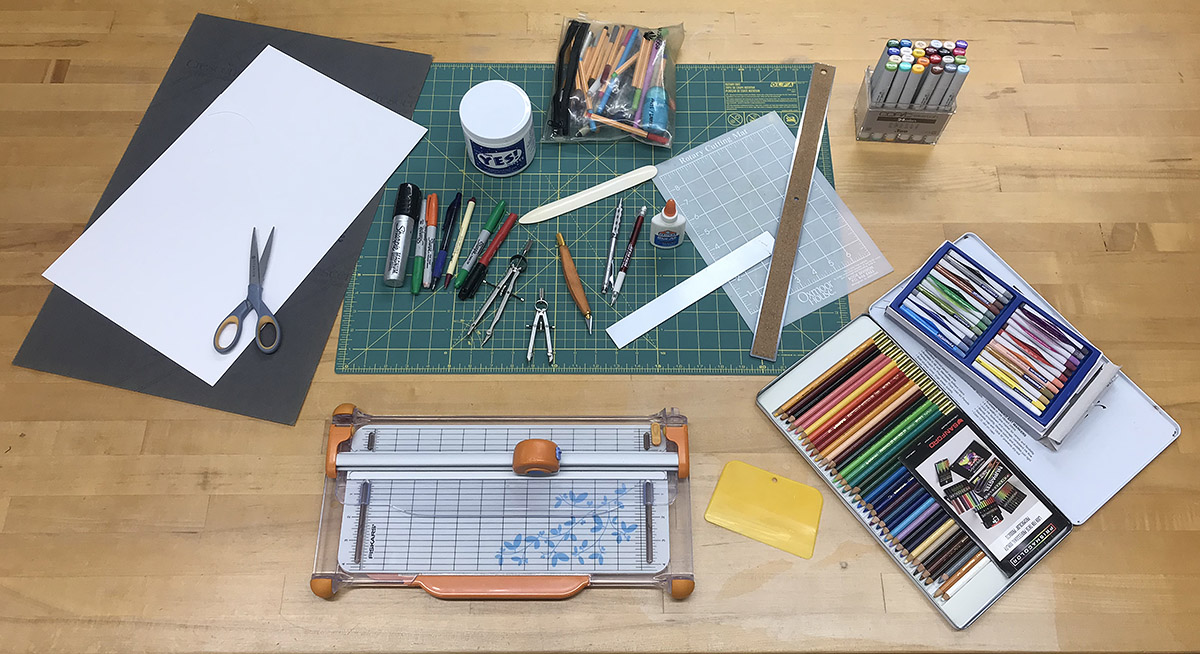
Shown are some of the tools and media that can be used to make a pop-up book. The dark gray board on the left is typical 4-ply matboard. The white paper is 80 LB Bristol . There are scissors, various pens, mechanical pencils, drawing compasses, a craft knife, two self-healing mats, an aluminum straightedge, a cork-backed stainless steel ruler, and colored markers in the bag at the top. The white jar contains YES! Paste. The little bottle is Elmer's glue-All. To the upper right, Copic alcohol-based markers. To the lower right are both watercolor crayons and watercolor pencils. The mustard colored tool is a glue spreader. The orange and aluminum item, center bottom, is a Fiskars rotary paper cutter. The bone-colored tool in the center of the green mat is a bone tool.
Tools for Paper Engineering
Although pop-ups can be created with just a knife and a piece of paper, you may find it beneficial to use tools that are more specialized to each task. For example, a bone tool is useful for creasing. Materials for making the book cover are not described here, and will be explained on the Cover Materials and Suppliers page.
You are already familiar with certain tools that work well with paper such as a pencil, straightedge, craft knife, scissors, white glue, cutting mat, and drawing compass. Other tools that can come in handy include a protractor, various triangles, a scoring or embossing board, paper trimmer, double-sided tape, self-healing mat, pounce wheel, “Yes! Paste” and a glue spreader. Many of these are simply conveniences, but some make creating your work much easier and more pleasant. Over time, if you enjoy the process of making paper art, you will find that your tool collection grows.
- Bone Tool: A hard, flat, smooth-edged tool that can be made from actual bone, teflon, dense hardwood, or hard plastic. It is edged but not sharp enough to cut paper. (See video at the end of this page for more information.)
- Glue: White glue such as Elmer’s Glue-All is a great tool for paper because it bonds well and is clear when dry, but can be difficult to use on larger sheets. If too much glue is applied, it will make the paper warp or wrinkle. “Yes! Paste” is another option that is easy to spread and has a low liquid content, making it more useful for attaching cover materials and other large sheets. It is acid free and archival, so it's a popular and affordable choice for bookbinders.
- Triangle: A drafting tool, usually formed at 90º, with the other two angles at 45º, or one at 30º and the other at 60º. They are used to draw perpendicular lines or those at the preset angles.
- Scoring or Embossing Board: A long board with grooves. Can make fold lines cleaner and easier to use. (Link: Making a DIY Scoring and Embossing Board)
- Paper Trimmer: A sliding cutter (with either a straight or a rotary blade), mounted on a track, which enables cutting clean, straight lines.
- Double-sided Tape: Try to find archival or acid free tape, to help the longevity of your piece. This is available in bulk rolls or in small disposable hand-held dispensers similar to correction tape.
- Self Healing Mat: Any cutting mat will work, such as a piece of stiff mat board or non-corrugated cardboard like the back of a sketch book. However, a self healing mat will last longer and ultimately make your cuts cleaner, as there won’t be obvious cut marks guiding the knife off course. A self-healing mat does not actually heal; rather, its rubbery surface parts when cut and pinches closed after the blade passes.
- Pounce Wheel: A rotary tool with teeth, good for tracing or marking the paper without pencil marks, or to make folds easier by essentially scoring the paper before you fold.
- Glue Spreader: A piece of plastic or other hard material that is impervious to the glue, and allows you to spread it evenly over large surfaces. Although not impervious, a piece of clean mat board or double-folded piece of bristol paper can be used as a spreader until it fails.
Using a Bone Tool:
Source: LCI Paper Video Page @LcipaperVIdeos