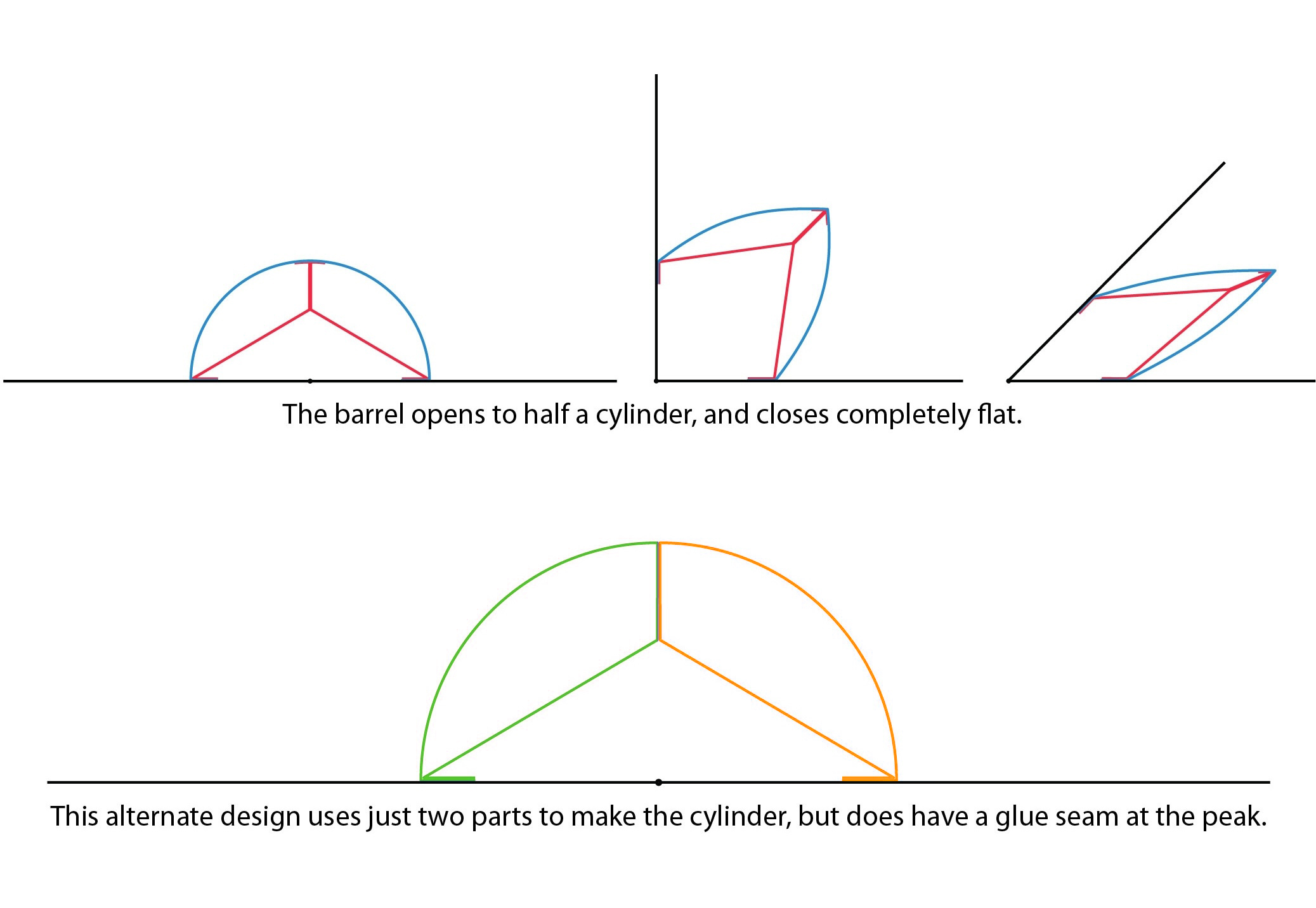
A Perfect Cylinder Centered on the Gutter (NOTE: MATH REQUIRED)
Barrel folds that use pull tabs are common in pop-ups, but ones centered on the gutter are not. They must fold at their peak when closing into the book. Also, to make the barrel an accurate half cylinder (half a circle arc), the tensioning members must be precisely proportioned. When the spread closes, each half of the barrel lays flat alongside each tensioning member. Therefore, each tensioning member must be the same length as the arc they pull on.
In the drawing below, notice that there is a minimum page size required to fit the cylinder into the closed spread, which is (X + r). In the top right of the drawing is an example of how to find the maximum size that will fit into your spread without sticking out of the book when closed.
Functionally, it makes sense to create a pop-up that is a little smaller than the absolute maximum that will fit. It is always better to leave a little bit of space between the outer edges of the page and any mechanism to reduce damage by fingers inadvertently grabbing it.
This method, and the "(d/5)" proportion described was derived through both logic and trial and error. While the "(d/5)" proportion is a very close approximate, the result will be a barrel that will very closely approximate a perfect half-cylinder.
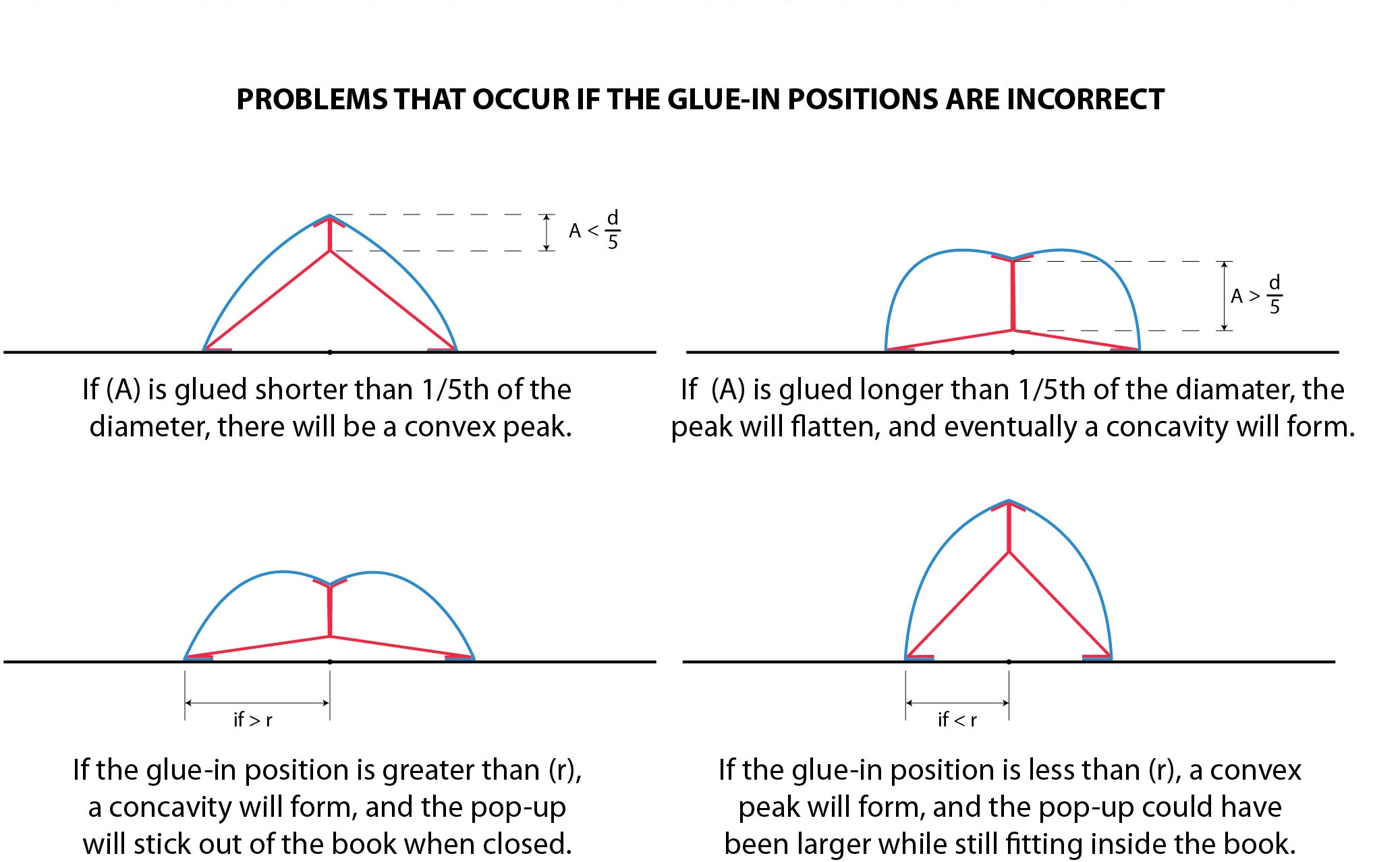
PROBLEMS THAT CAN OCCUR:
Besides the critical dimension of equal overall lengths between tensioning members and their corresponding arcs (A + B = X), another critical measurement is that (A) must be one fifth of the diameter of the barrel. This proportion is the only one that makes a perfect cylinder. If (A) is longer than 1/5th, the barrel will bifurcate into a shape that forms a concave fold at the center. If (A) is shorter than 1/5th, the result will be a convex fold at the center. The third critical dimension is that the pop-up is glued-in spaced away from the gutter by the radius (r). If it is glued-in shorter, a convex peak will form; and if glued-in longer, a concave crease will form.
Taken to extremes, if (B) equals the radius (r), there will be a maximum concavity. If (B) is shorter than the radius, the spread would not be able to lay flat. However, if (A) equals zero, then the barrel curves will cease to exist entirely, forming the flat sides of a triangle.