Student Examples, Maquette Project
A series of maquettes can be made from complex or simple materials, depending on your desired outcome. For pure experimentation, simplicity is best. The scale should fit the speed by which you wish to work, the availabilty of materials and processes, and the space you have to work in. If you are working on a single maquette that will be shown for a commission, which must demonstrate technical and material properties as well as concept and aesthetics, then a larger and more sophisticated maquette is warranted. Otherwise, the quickest and easiest approach is best. The purpose is to get ideas out quickly.
Dennise Sosa, Spring 2026
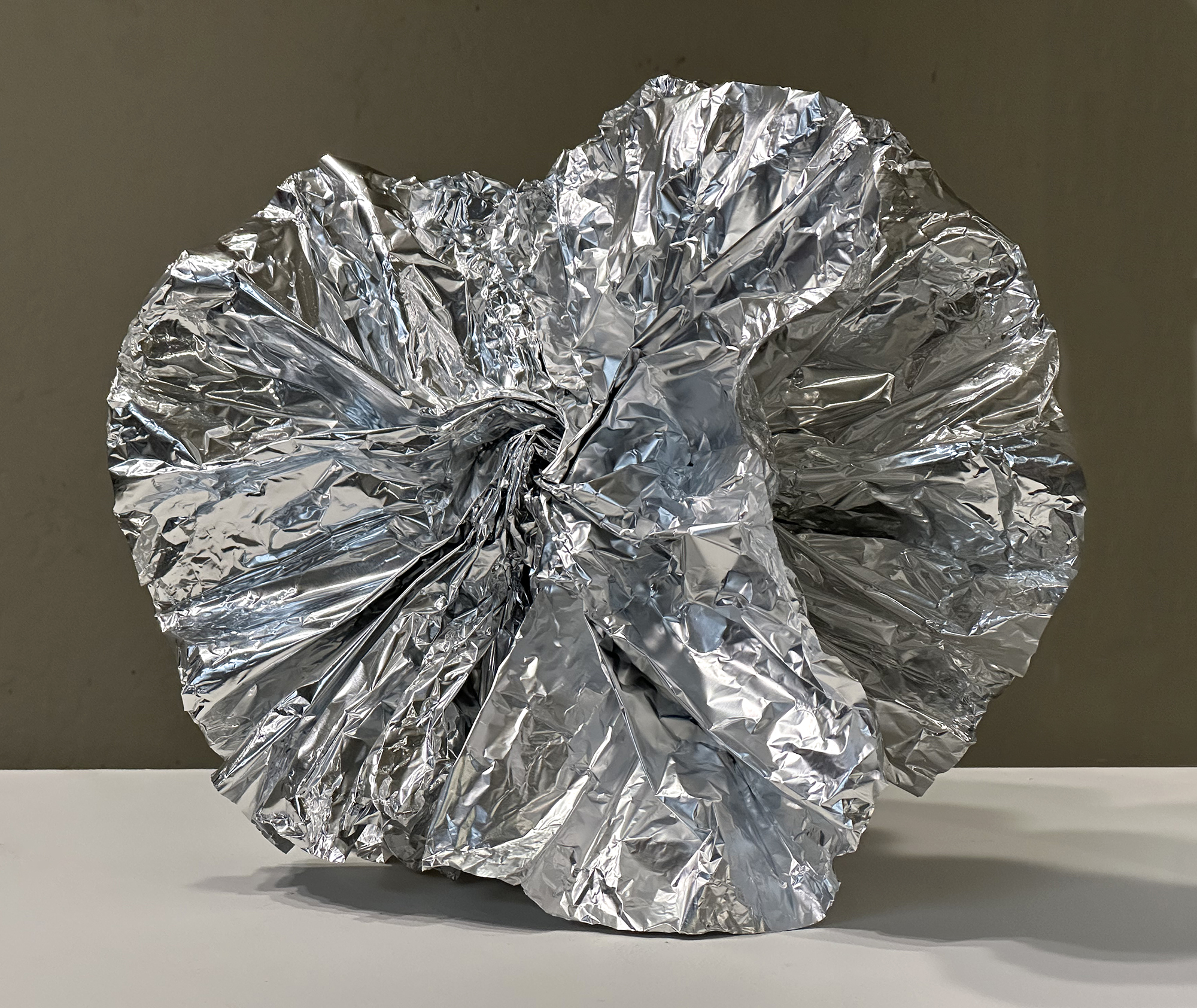
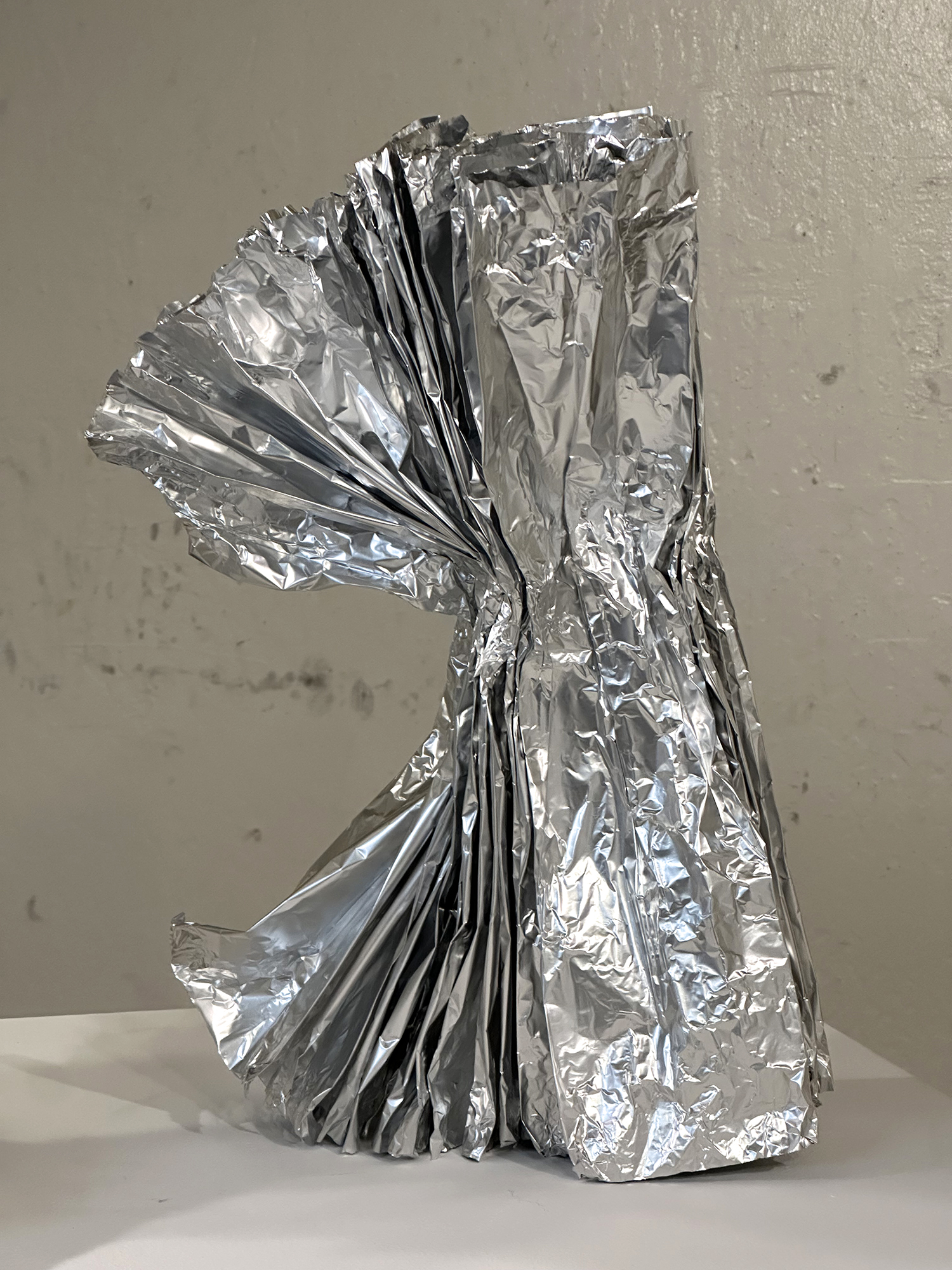
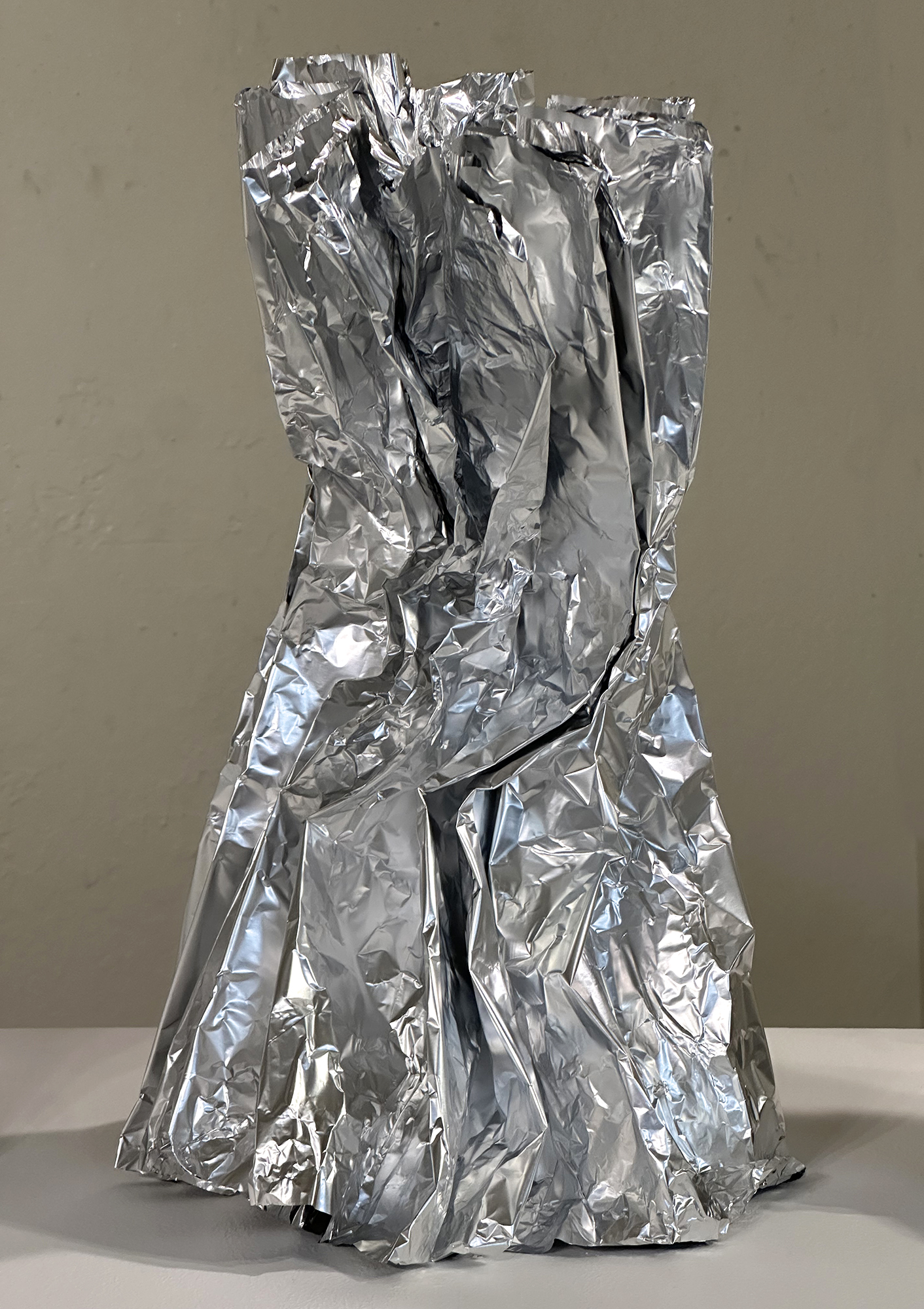
Dennise Sosa was interested in working with textiles, and wanted to experiment with folds and pleats. She played with the idea of crushing and squeezing. All nine of her maquettes were made in one class period from restaurant-grade aluminum foil. The forms were made at the given height of the foil roll. After placing the collection on the floor in the classroom, with no room to view them, we determined that they needed to be seen in a row in an open gallery space.
The depth of shadow and reflection was striking, which enhanced the movement of the folds and wrinkles. Dennise focused on the idea of vortex in some of the pieces. Others were predominantly about twisting vertically. Several experimented with impact, giving the forms an asymmetry and a feeling of rapid collapse. in some cases the tops open to a hemisphereical burst, reminiscent of flowers or explsions; heat rising. In general the forms evoke the growth patterns in plants. An observer thought that the collection felt like a series of dancing dresses in space.
After leaving the pieces in their initial lineup, we experimented with juxtaposing two forms in dialong with one-another, seen in the final two images below.
Several ideas came from viewing these maquettes. One was to experiment with laminatiing the foil, making it tougher and more capable of being made larger-scale. Dennise laminated two sheets together with spray adhesive, and made another sample with fiberglass mesh in its core. These samples provided rapid feedback in how the material felt and could be manipulated. Another idea that she will work on is creating a large installation that requires viewers to fully engage with the work in a room, or corner.
From the artist:
"Making the maquettes with aluminum was very refreshing because it allowed me to play around with the idea of “crumpling” without being limited by time and supplies. The stiffness and reflective nature of aluminum inspired even more ideas for textile manipulation and for seeing how much I am able to transform its surface."