Spread Assembly
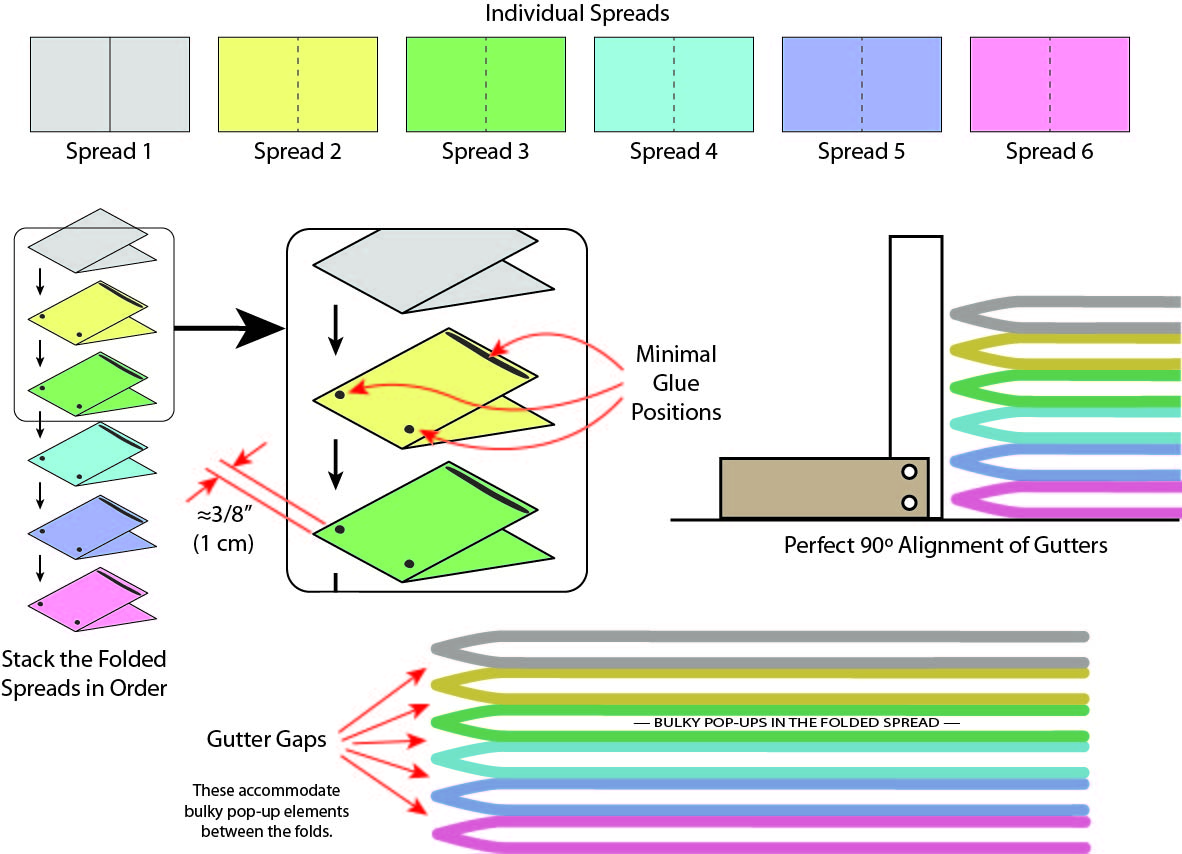
Pop-up books require a specialized assembly of spreads. It is closely related to how a board book for toddlers is made - with no stitching, and rigidly flat pages. A board book has no cover or spine, but pop-up books do. A board book is made from rigid board, while pop-ups are made from Bristol paper, cardstock or other stiff paper. Gluing the spreads to one another makes the pages stiffer still. This stiffness is what gives the book mechanical leverage.
Typically for a hand-made book, each single-sided spread is a complete object in itself, and then joined together to make the book. The reasons for this are to allow the spread to lay flat when open and to accommodate the extra thickness of closed spreads due to mechanisms and pop-ups between the folds. Professional pop-up books are often printed on long continuous sheets, where uncut spreads are joined end to end, and are then corrugated together making for quicker assembly. The length of these rows is related to the scale of the paper and printing machinery (see an example under the "Hidden Mechanisms" section, below).
Precision Alignment of Folded Spreads
For proper functioning of your book, all folded spread gutters must be aligned to one another evenly and squarely. Otherwise problems will arise when opening each spread flat. Poorly aligned gutters can force a spread to not open flat, and can make attaching the cover more difficult. Covers and binding will be described in detail on a separate page.
To align the folded spreads properly, it is helpful have on hand something heavy and blocky that has a 90º edge to use as a reference. Lay the last folded spread flat on a table with the gutter pressed up against the reference. Stack the next to last folded spread on top of that one, careful not to misalign the one below it. Slide the newly placed spread so that its gutter also abuts the reference. Although not critical for function, see that the all of the other edges look aligned to their mates as much as possible. Continue this process until all folded spreads are stacked and all gutters aligned.
You can use binder clips, paper clips, or simply add weight to the top of the stack to keep the stack in alignment so that glue can be applied where necessary to form the leaves. It is best to glue the opening edges of the spread's pages first before adding glue near the gutter because then the clips can be removed and then glue added near the gutters and elsewhere.
An alternate way of aligning the gutters is to pick up the entire stack of loose, folded spreads, and tap the gutters against the table until they are squarely aligned by eye.
Another approach to gluing is to put small spots of glue on the first folded spread's underside, then align one spread at a time. Let the spots set before attaching the next spread. After all spreads are attached and in perfect alignment, add the rest of the glue as necessary, including the locations offset from the gutters.
Gap Between Gutters
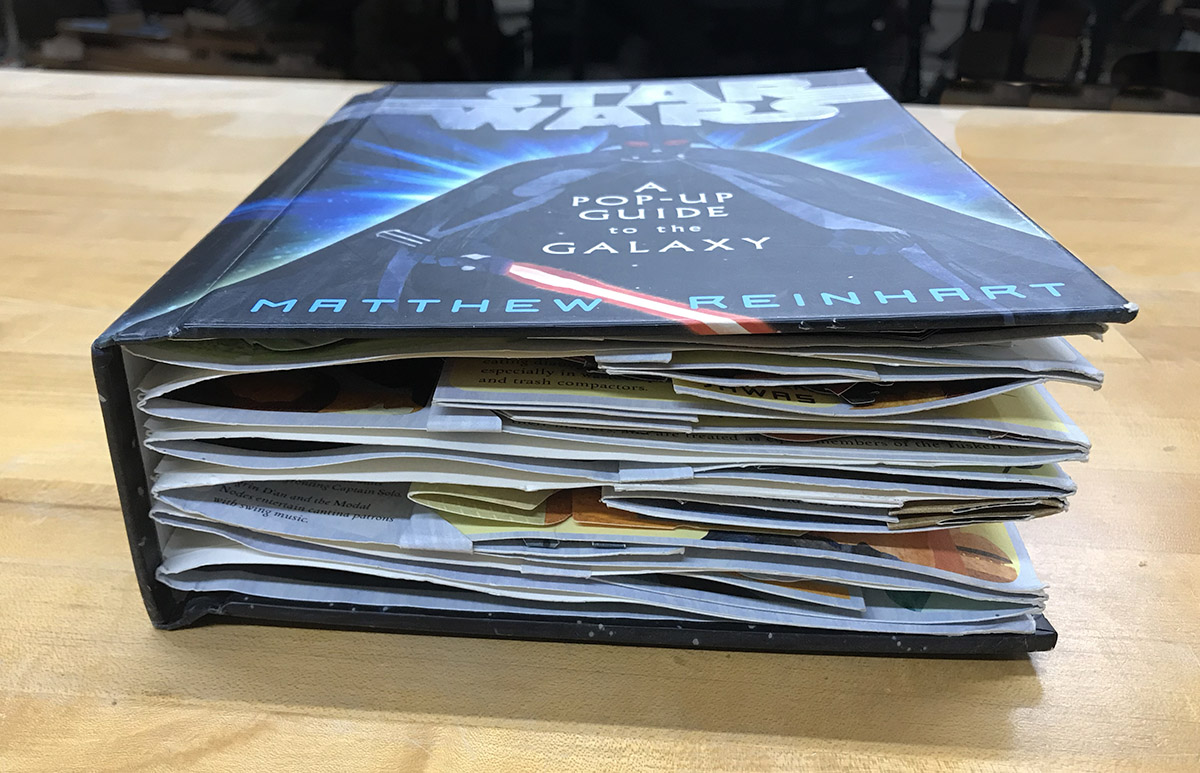
The above book is an example of extreme thickness and gapping between spreads due to bulky pop-up mechanics. The gutters are in alignment to the cover spine but are very far apart. The adhesive had to be placed far from the gutter.
Normal book pages are tightly met at the gutters. The opposite is true for pop-up books, which require that the gutters lay flat when open and flex to accommodate thick mechanisms when closed. This means that spreads are only glued to one another in certain locations, and not too close to the gutter. The amount of space between glue and the gutter is determined by how much bulk there is between the faces of any given folded spread. Some pop-up books require little space, and others a very large amount.
The gutter gap can be determined by stacking all finished and folded spreads on top of one another and seeing how much space the stack takes up. It is also possible to apply a general rule to this: keep glue about one centimeter or 3/8" from the gutter for most pop-up books. Really thick pop-up mechanisms will require more of a gap.
Hidden Mechanisms Between Leaves

This book has many complex mechanisms between the leaves. These require a pocket and slip sheets to allow the mechanisms to move unimpeded. First image: view inside the leaf area. Second image, the artwork side. Note how the leaves are joined together because the publisher was able to make them in continuous rows.
The spreads are folded at the gutter, which is centered on the spread. The artwork side of the spread is the visible side. The underside of the spread can either be completely devoid of mechanisms, or full of hidden mechanisms which are necessary for action on the artwork side. If hidden mechanisms are required, the space between one spread and the other (the leaf) forms a pocket to allow movement of the mechanics.
Careful consideration must be taken to assure that hidden mechanisms in the leaves between spreads have sufficient clearance for movement, and that the spreads are adequately attached to one-another so the pages remain strong. An improperly joined leaf between spreads can unfold outward when a book is opened.
If mechanisms are required on the back of both spreads attached to form the leaf, then a thin slip sheet between them will be necessary to prevent these mechanisms from interfering with one-another. That would be disastrous.
A slip sheet must also be employed whenever any part of a mechanism interferes with another.
Openings on the Edges of Leaves
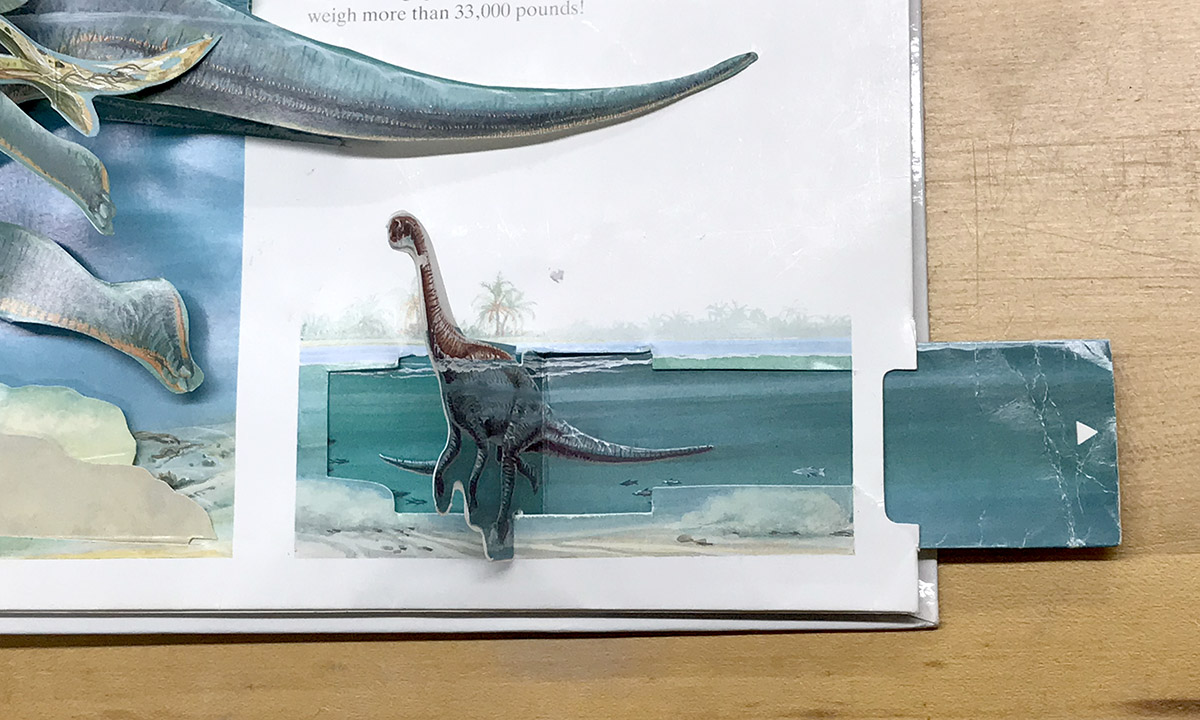
A pull tab mechanism on the right edge of a spread. This requires a gap within the leaf area for free movement, and the leaf edge needs to be joined with a glue tab so the edge remains loose inside.
Some mechanisms such as pull tabs or spinners can require openings along the top, side, or bottom of a leaf. This gives space for fingers to grasp the mechanism. It may be advantageous to design the opening in such a way that the person cannot access the mechanism from the wrong side of the leaf. For instance, it is not good to pull a tab that lifts a pop-up if its spread is closed. The pop-up or tab can be destroyed.
There are different ways to design the opening for ease of grip and smooth movement of the mechanism. The edges of the opening also can act as a stop for the mechanism to not move beyond its parameters, otherwise a mechanism may be damaged, feel sloppy, or simply not work as expected every time.
To accommodate for a leaf edge opening, the pocket at this location must not be glued flat together. Instead, a glue tab must be employed to form a sharp, glued fold along the edge. This glue tab serves to structurally tie one spread to another while allowing mechanisms to move all the way up to the fold.