Tent Folds

ABOVE, the parts for five types of Tent Folds. Tent Folds have glue tabs that align parallel to the gutter.

The Tent Fold is a variation of an Acute Scenery Flat - and visa versa - with the exception that the spread is opened to 180º, rather than 90º. In all cases, glue tabs that attach to the spread run parallel to the gutter. If this was not the case, the pop-up would actually be a V-Fold.
Even Tent Fold
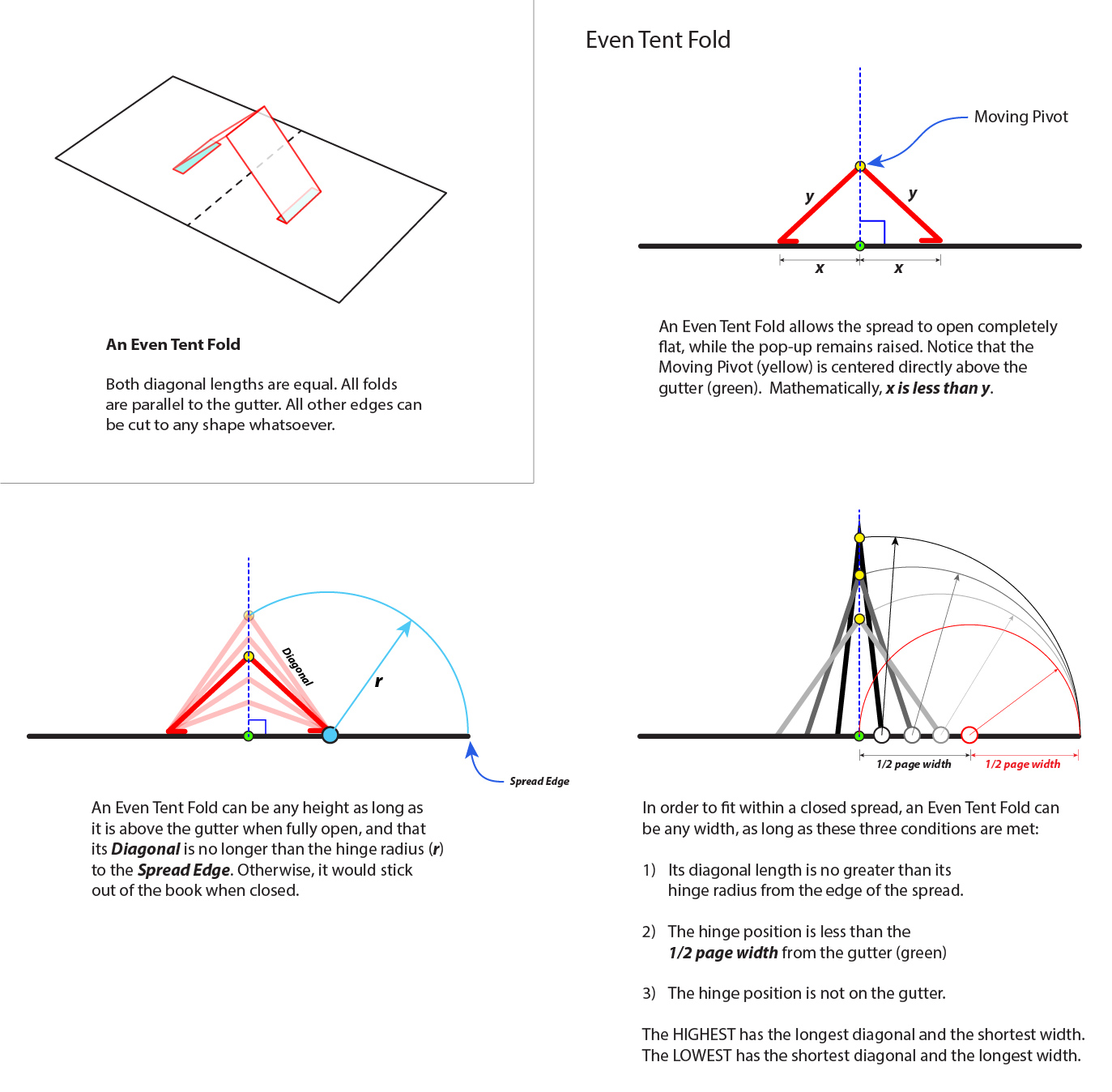
An Even Tent Fold requires that the apex of the fold is centered on the gutter. The reason for this is because if both slopes are of equal length, then the glue tabs would be equally far from the tent's fold line, therefore, when closed, the glue tabs would align. This means that no matter where the first glue tab is placed relative to the gutter, the other one would be exactly the same distance away on the opposite side. This places the tent's fold line directly above the gutter. The alignment of these two can come in handy to direct a more complex mechanism to be in line with the gutter.
There is no correct angle or length to the diagonal, as long as it fits within the closed page and stands above the gutter.
Uneven Tent Fold
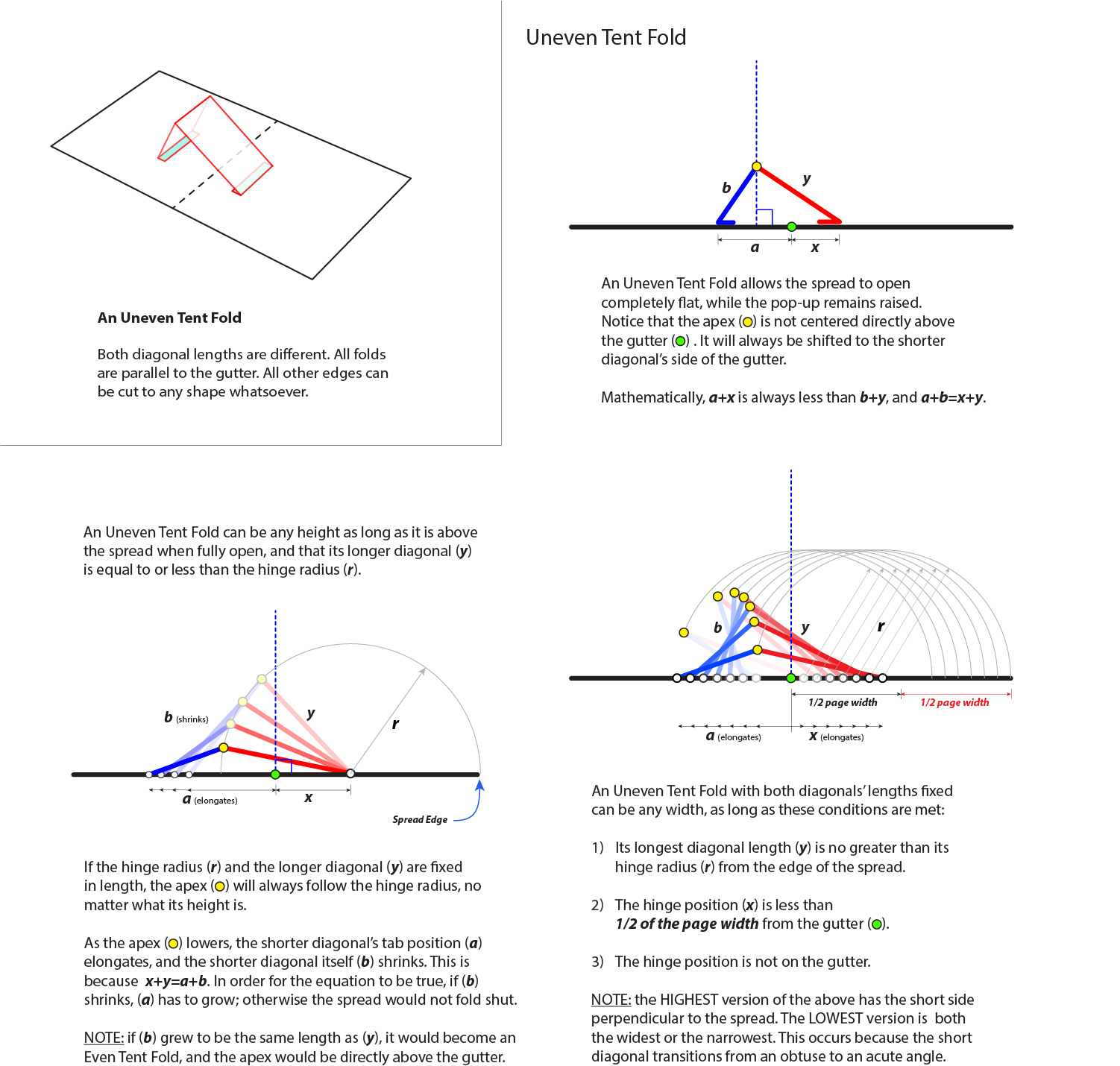
An Uneven Tent Fold's apex is always parallel to the gutter, but will not be perpendicular to it. This is because the longer diagonal must be glued closer to the gutter than the shorter diagonal, otherwise the shorter diagonal would not align to the other half of the spread. The shorter diagonal will automatically glue further away from the gutter than the longer diagonal does. As the longer diagonal moves further from the gutter, the shorter one follows suit.
It is best to glue the longer side in first and let the shorter side automatically locate itself.
Sloped Tent Fold
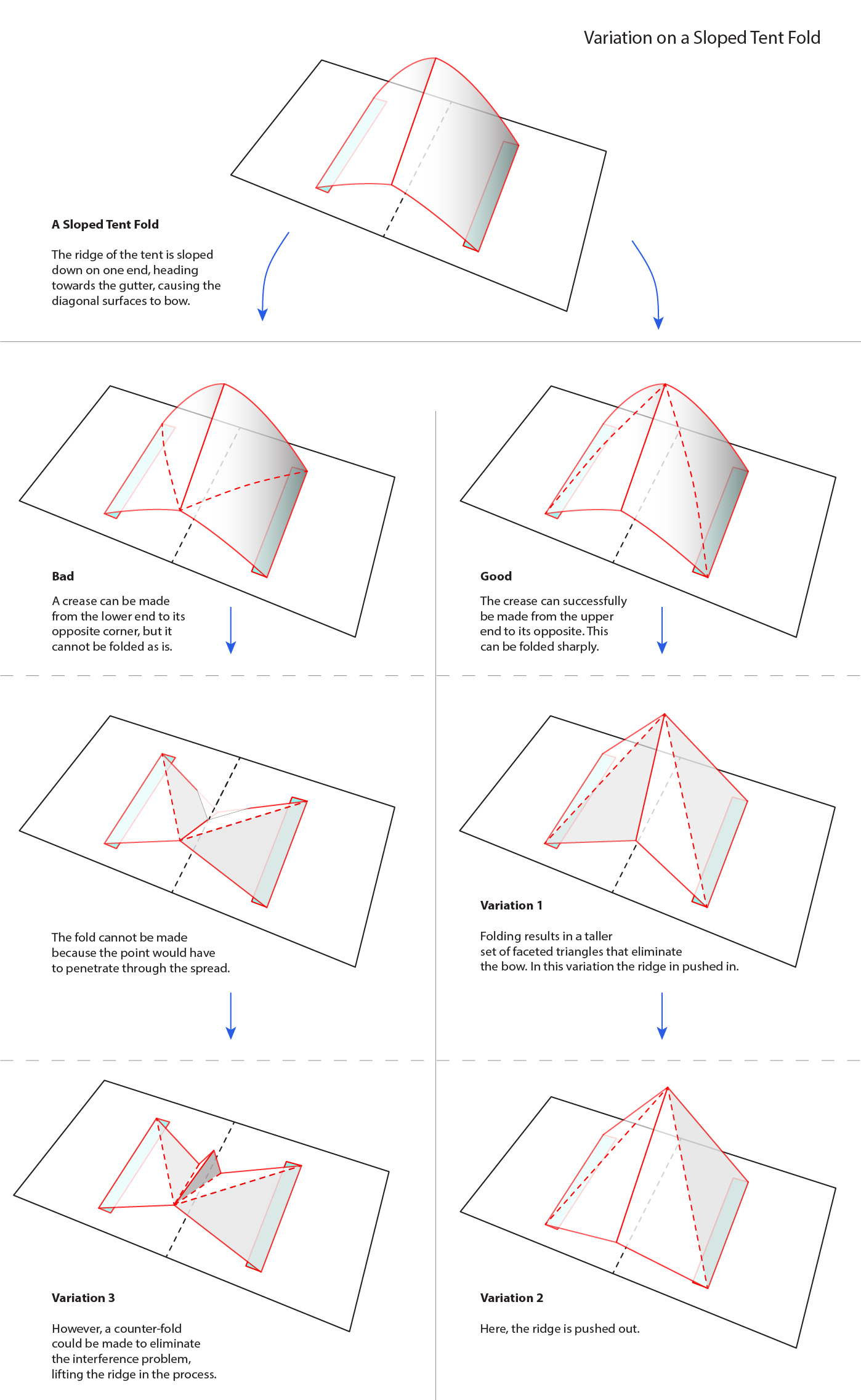
A Sloped Tent Fold allows the ridge to be out of parallel to the gutter and introduces a curve to the pop-up upon opening. This curve continuously changes along the diagonal, and can be used to create organic objects. There is stress added to the surface as it changes from flat to bowed.
Each side of the sloped tent fold forms quadrilaterals (4-sided polygons). Each quadrilateral can be subdivided into two triangles, which will negate the curve. Another way to describe this process is "faceting". Faceting takes the stresses out of the surface.
Converting a sloped tent fold into a faceted tent fold
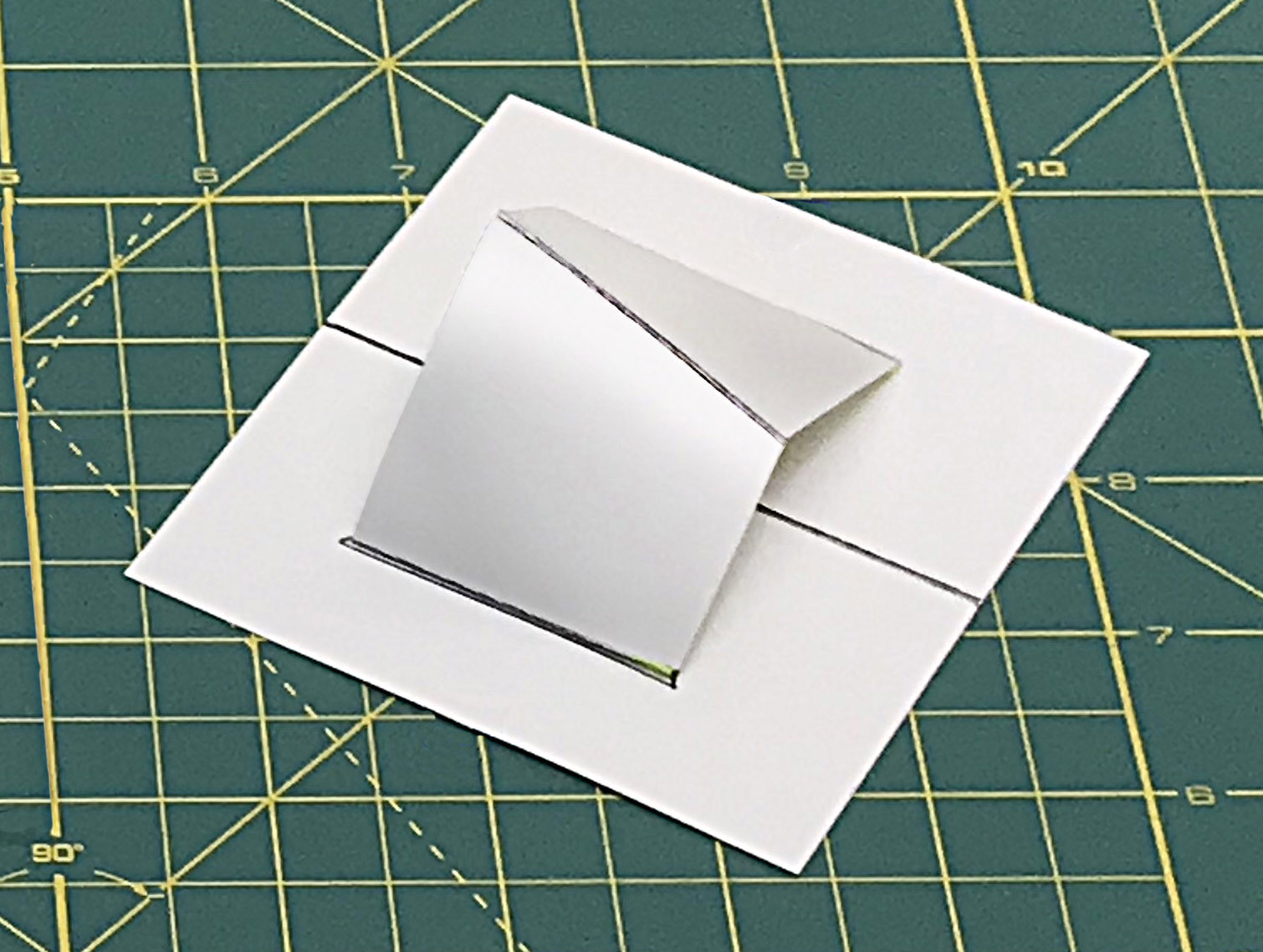
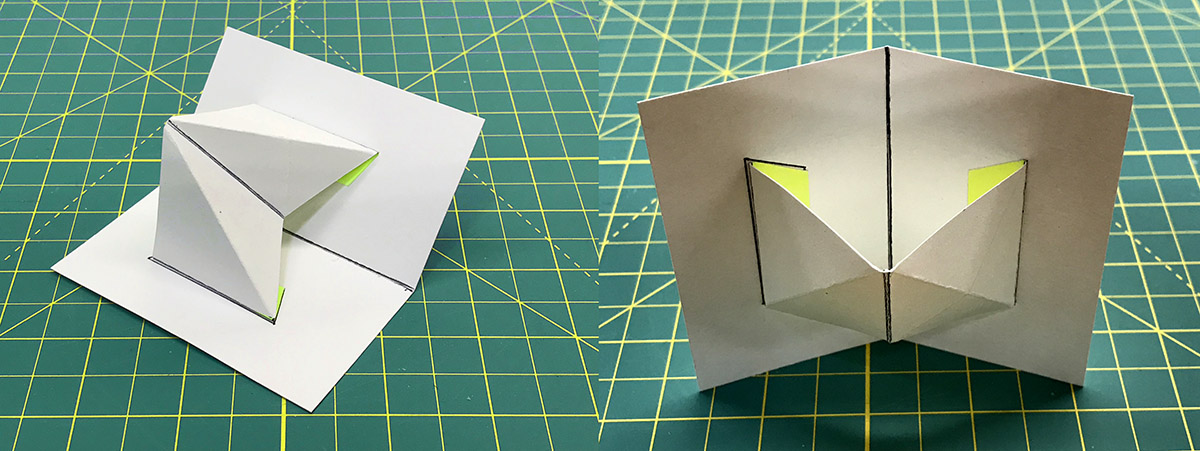
The photographs above demonstrate how a Sloped Tent Fold can be faceted. The faceting was done to this model after it was originally assembled with its curved surfaces intact. One glue tab was pulled away from the spread, the folds were made, and the tab was re-glued. Because the original quadrilaterals were bowed and under stress when open, the new triangles can both be pushed inwards or outwards and still work properly. The triangles were mirrored to allow the new design to close within the folded spread.
Closed Tent Fold
A Closed Tent Fold is an extension of the other tent folds already described, with the exception that the open ends have extensions that can form enclosures. These enclosures can be any length that will allow for the spread to be fully opened, and so that the extensions do not stick out of the book when closed.

Supporting Videos
A 24-minute demonstration of the five types of Tent Folds shown in the images, and how they are glued in place.
A 1-1/2-minute video showing three real-world Tent Fold examples.
A 1-1/2-minute video showing a fold modification to the Sloped Tent Fold from the Demonstration video.
A 3-minute video showing an experimental fold idea that doesn't work out well.