SUPPLEMENTAL: Determining Support Arm Specifications
NOTE: There are two distinct ways of creating pop-up mechanisms:
- The first is simply through trial and error. This allows you to come up with mechanisms that may - or may not - do what you expect or teach you what is really going on.
- Another approach is to figure things out geometrically through drawings.
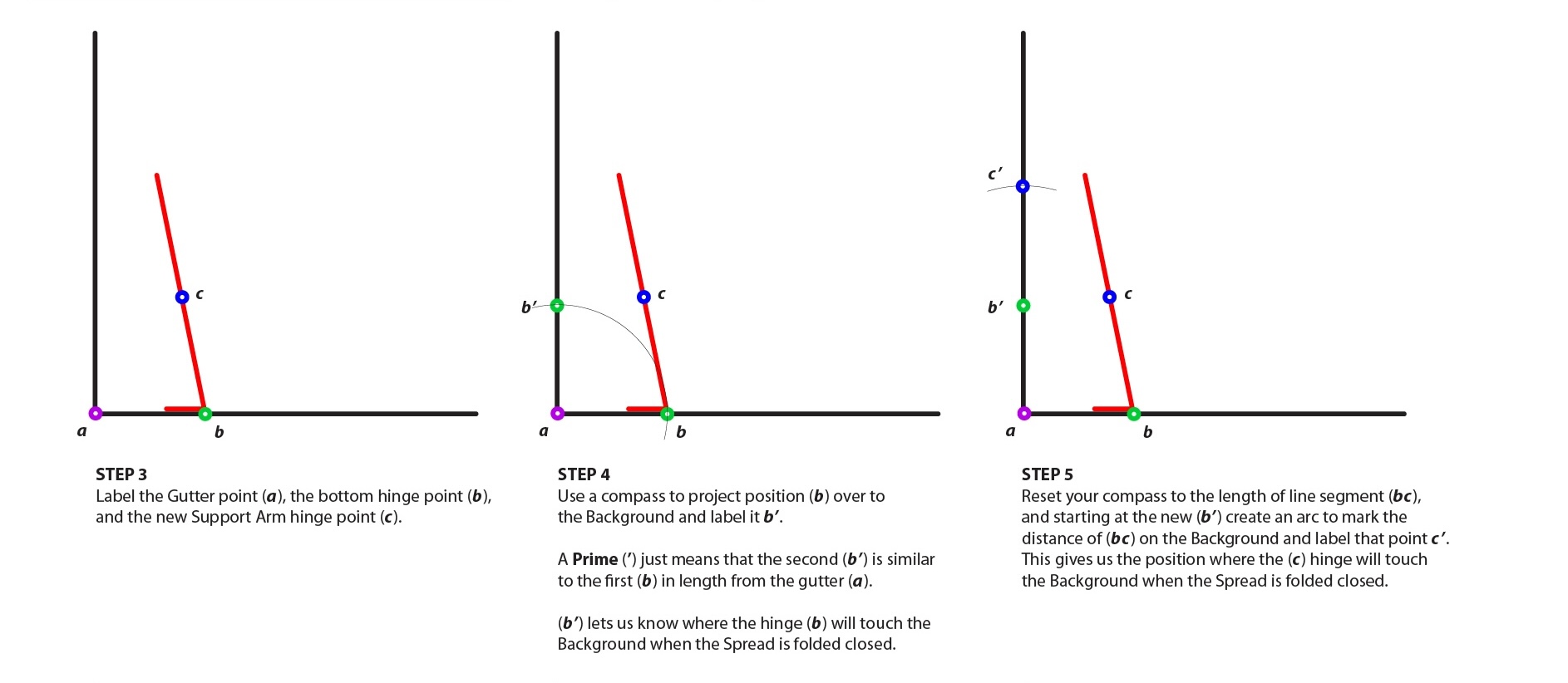
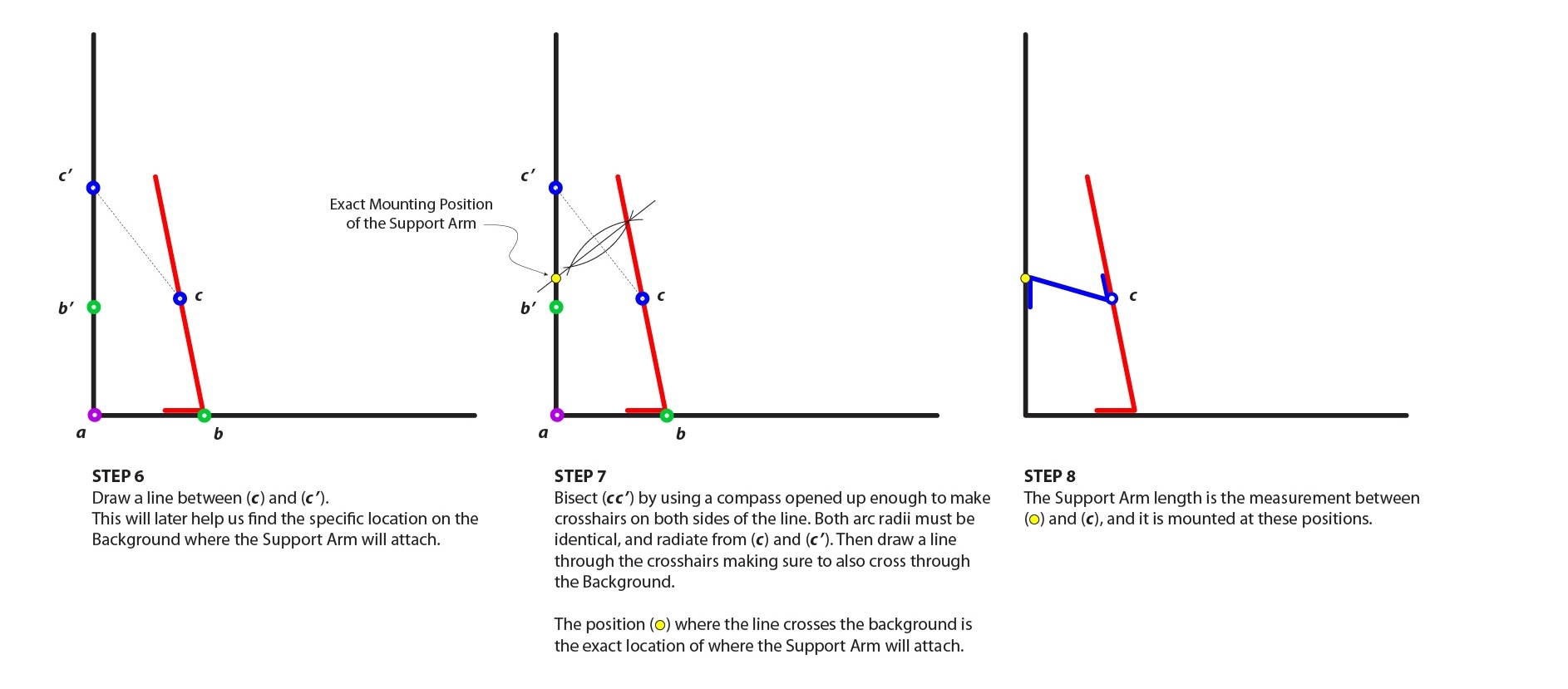
The process illustrated n this page is the result of many years of attempting to understand how to create compound platforms. Whenever the Pop-Up Book Project came about I would pose this problem to a few students. I knew in theory that there had to be a way of understanding how to make it work. I reached an "aha" moment when I realized that transferring dimensions with a compass, and good old "Bisecting A Given Line Segment", solved the problem without numbers.
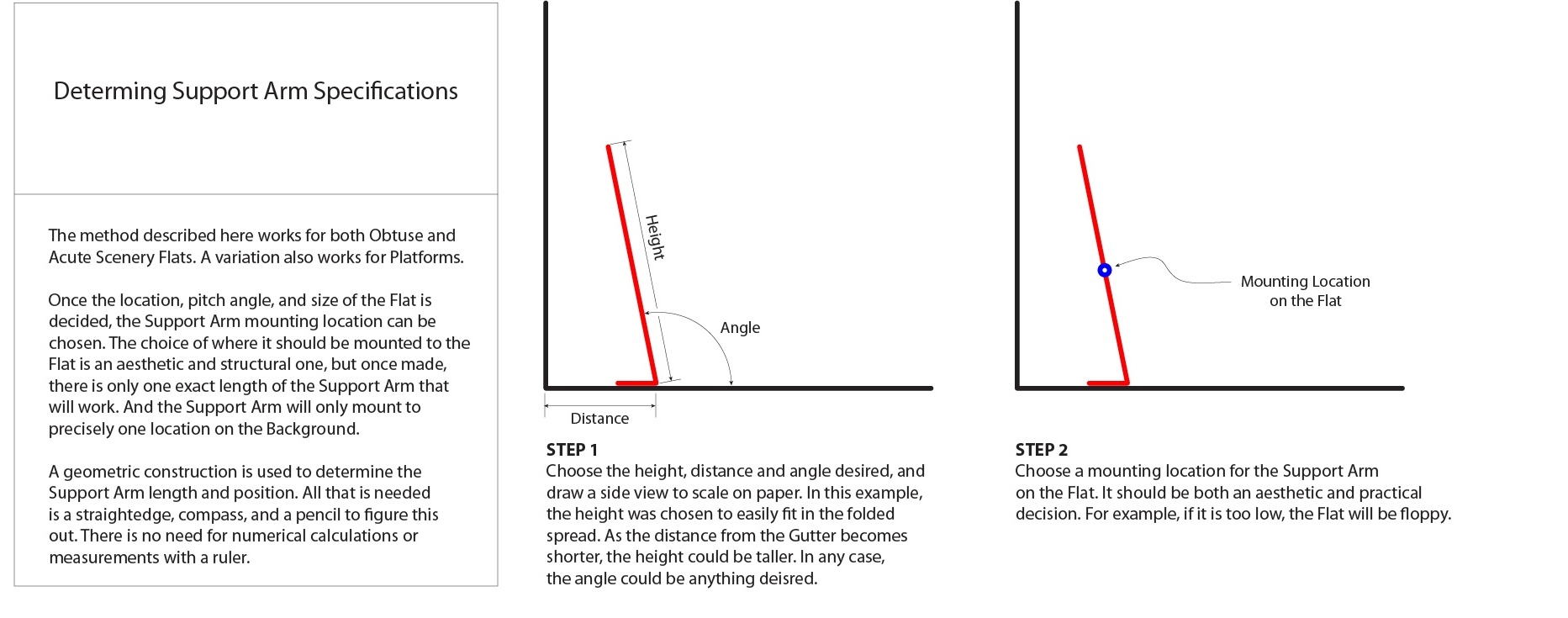
I wish to make abundantly clear that this stuff is complicated - that although the information is knowable it is not easy; nor am I expecting you to know it. Below is my method, tailored for Obtuse and Convex Scenery Flats, explaining every step. The last image on this page depicts my original solution to the compound platform problem.
Method
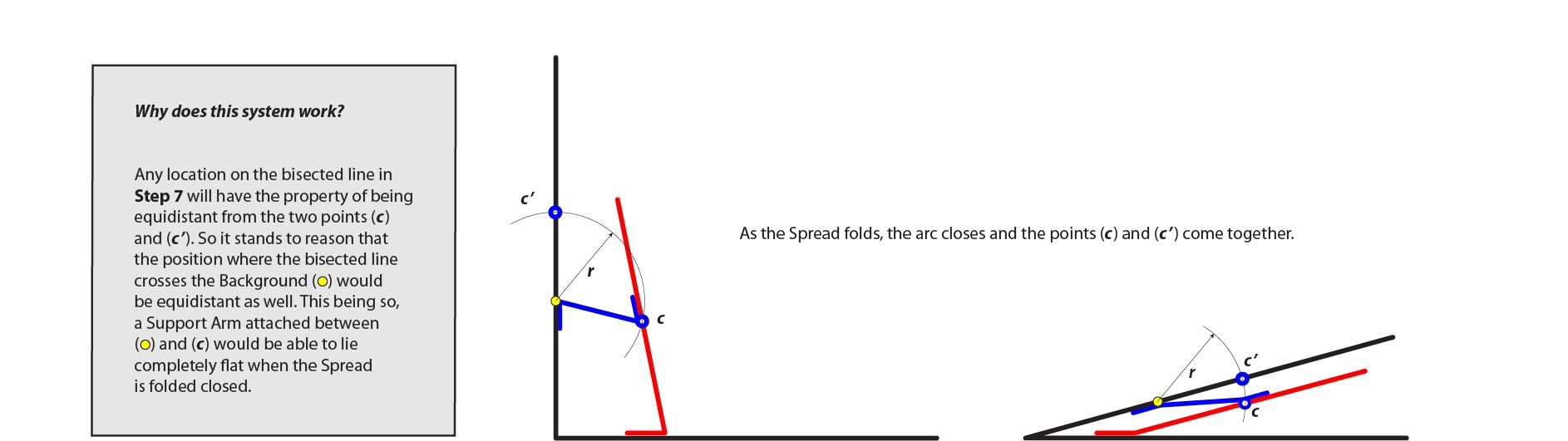
Proof
Calculating a Compound Platform

The drawing, above, was made in 2020 in an attempt to figure our how to lay out a compound platform, such that the platform was an irregular mountainous surface that goes up and down like a line chart across the spread. It had to both open to its 3D form and fold completely flat when closed. I first drew the straight line depicting the left page, then the position of the gutter on the right, and finally the changing line of the compound platform. This is when the uprights had to be calculated. The solution was in finding the "lay-down" locations that corresponded to the "stand-up positions relative to the length of the uprights.
Notice that "Point F"has two possible alternate locations that both work; one being convex and the other concave.
NEW PROBLEM POSED:
How can a smoothly undulating surface be created that closes completely flat and opens similarly to the compound platform above, but with no obvious sharp transitions?