V-Folds
Basic V-Folds
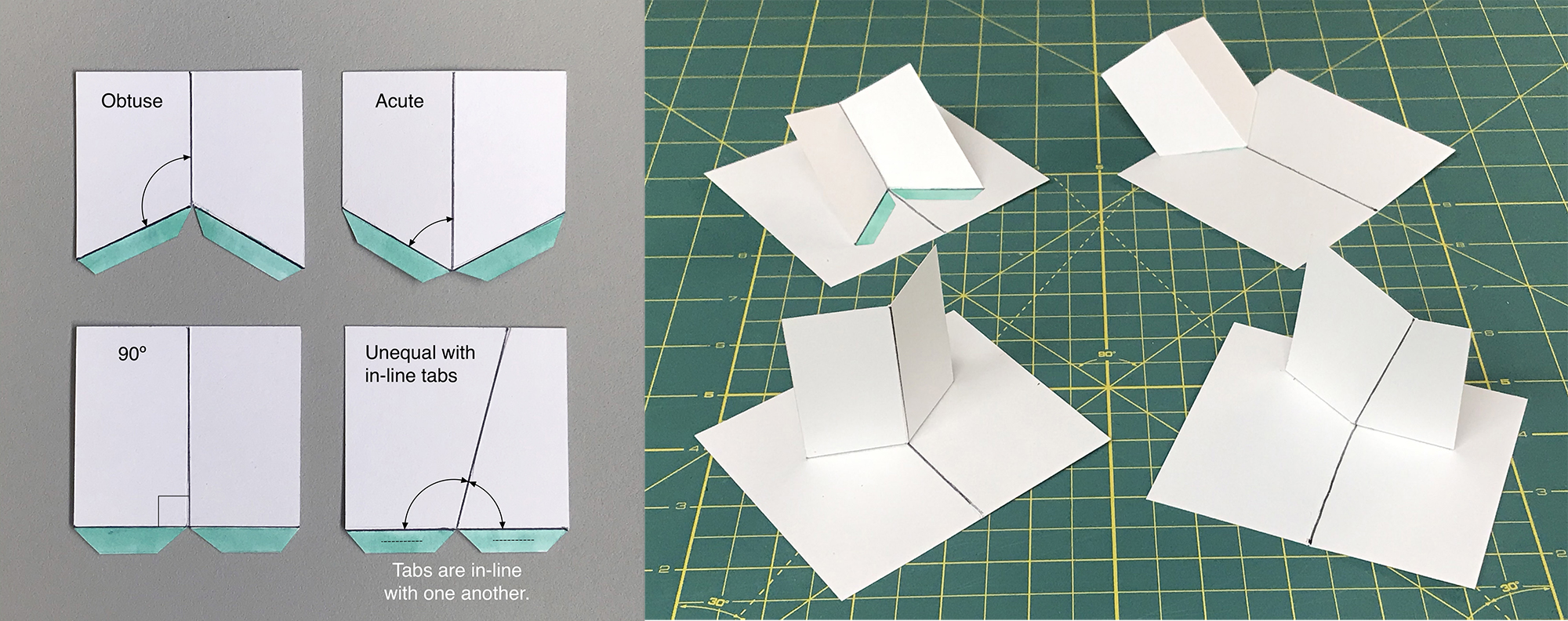
The V-Fold is a very common and physically powerful mechanism. The first three variations above are considered "regular" because the angles between the central fold line and the tabs are bilaterally symmetrical. The fourth is not bilaterally symmetrical, though it does have tabs that appear regular at first glance. Each type has its own unique effect.
Shown from top left to bottom right are:
- Obtuse V-Fold (this makes a concave fold)
- Acute V-Fold (this makes a convex fold)
- 90º V-Fold
- Unequal V-Fold with in-line tabs
Obtuse V-Fold
Although the obtuse v-fold is not used as often as its cousin, the acute v-fold, it has its place in the v-fold family. This mechanism can be used to make any visual form where you wish to see the concavity formed by the seam of the object, or where an object needs to lean away from both the viewer and the gutter. Of course, this mechanism could be aimed towards the viewer for a different affect, such as the bow of a ship coming towards you.
There are three mechanical/spatial design decisions that can be varied to achieve differing outcomes with this mechanism. The first is the cut angle. It can be anywhere from greater than 90º, to shy of 180º. As the cut angle grows, the object leans more and more away from the viewer.
There is another angular decision that affects the object's ultimate tilt. This is the angle at which the v-fold is glued onto the spread (the glue-in angle). This angle can be anywhere from more than 0º to just shy of the total angle formed by the two cuts defined by the cut angle. A small glue-in angle will tilt the object less, and consequently imparts less movement upon opening the spread. As the glue-in angle increases, the object will lay down further. The glue-in angle can never be 0º, because if it was, the v-fold would simply become an I-Beam that does not spread apart at all. Likewise, it can not be glued-in at the cut-angle, because the object would simply lie flat on the page with no swing at all.
The third design decision is position, or it is placed along the gutter. If it is far back, the mechanism will almost assuredly stick out of the spread when closed. In this case, a small obtuse v-fold should be employed. On the other hand, a big obtuse v-fold must sit as far forward as possible to avoid protruding out the folded pop-up.
Acute V-Fold
Acute v-folds are very common and can potentially be visually and mechanically powerful. This mechanism is often used to make forms that project above or below the top or bottom edge of the spread as the pop-up is fully opened. It disappears completely between the pages when the spread is closed.
Like the obtuse version, the acute v-fold has dimensional and positional design considerations, and has upper and lower limits to its angles. In this case, the cut angle can be anything between 0º and 90º, as long as it is neither of those. If it is closer to 90º, it will tilt very little. The more dramatic the angle, the more tilt it will have.
As with the obtuse version, the acute cut angle affects the glue-in angle. Lesser cut angles reduce the maximum glue-in angle. The smallest glue-in angle must be more than 0º and less than the cut angle for the same reasons mentioned for obtuse. By making the glue-in angle as wide as possible, you can make the swing of the v-fold very fast when opening the spread. This allows the V-Fold to lay nearly flat, and project far outside of the spread. The wider the glue-in angle, the stronger the effect. However, if it is glued to its limit, it will not pop-up at all. If you glue beyond the limit, up to 180º, the spread will not be able to open to 180º (this can be deliberate). If you do this, you cannot guarantee which direction the v-fold will go when closing the spread; it may flip and fold the opposite way you planned.
The acute v-fold position along the gutter is critical. The goal is to make it fit within the spread when closed while also making the visual effect as strong as possible. Its positional considerations are opposite that of the obtuse version. The closer it is to the top or bottom of the spread the more it protrudes when opened. Maximum size is achieved when its corners are touching the edge of the spread.
90º V-Fold
The 90ºV-Fold will automatically stand perpendicular to the opened spread, no matter what angle is chosen when gluing up. Also, if each tab is placed at 45º to the gutter, the pop-up will be perfectly squared up. This is useful for making pop-up rooms and other building structures. It is not important that the angle is exactly 45º though; only that it appears so. NOTICE: the gluing procedure for proper functioning is very specific and will be described in detail later in this section.
Unequal V-Fold with In-line Tabs
The fourth example shows the tabs in-line with one other just like in the 90º example, but these tabs can be created at any angle, such as those in the Obtuse and Acute examples. The important characteristic that makes the Unequal V-Fold unique is that the fold angles differ .
Glue Tab Basics
Positioning
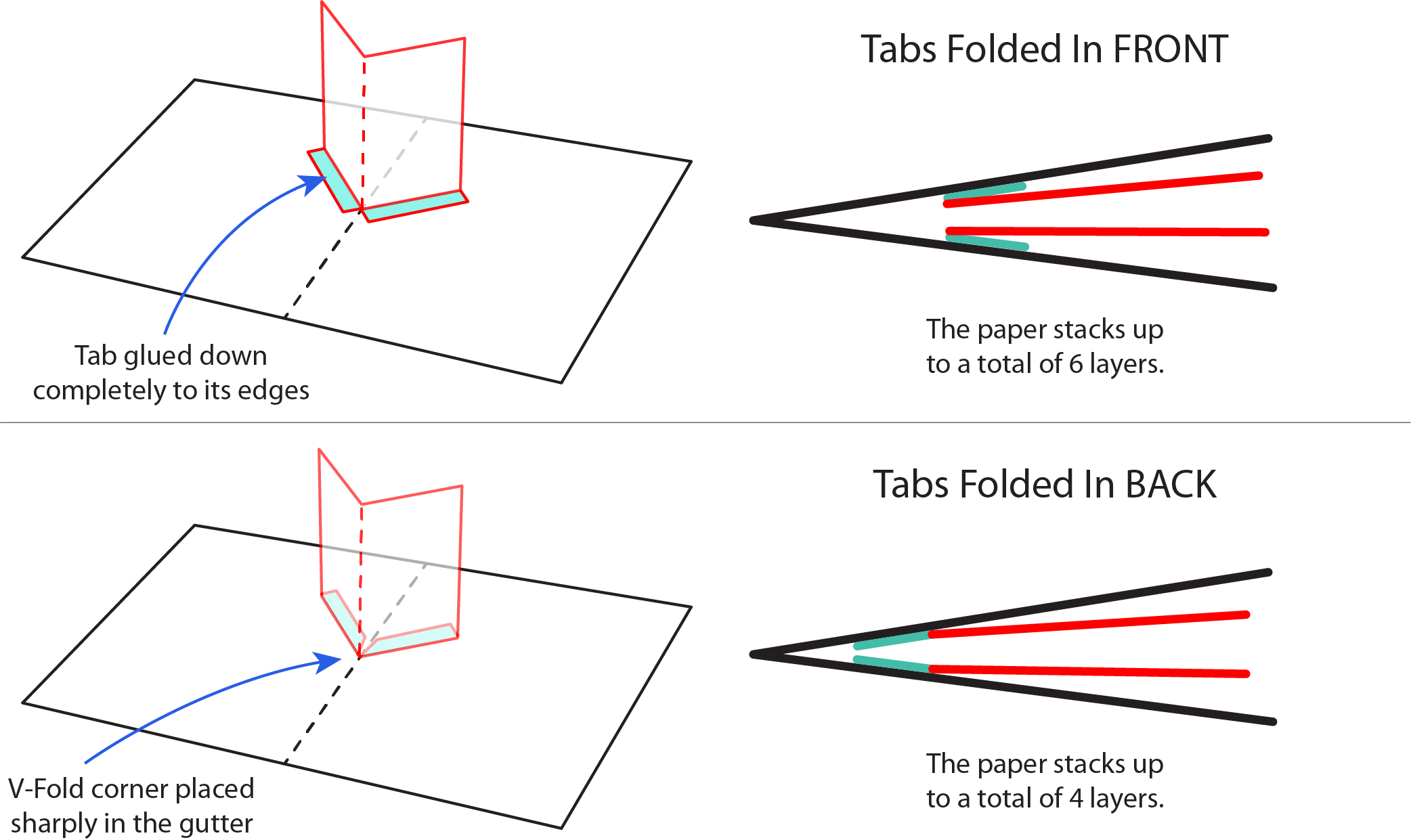
Tabs have two dimensions: LENGTH, which runs the length of the paper; and DEPTH, which is the amount it is offset from the fold. V-Folds require tabs for attachment to the spread. Tabs need to be deep enough for easy, strong gluing. If they are very shallow, they are harder to glue, not as strong, and can easily lose their straitness when wet with glue. If the tabs are too big, they are unsightly, awkward, and can interfere with other elements of your design.
A good starting point for the depth of a glue tab is 1/4”, or about 6mm. This is strong and easy to work with.
Often, tabs are glued down in such a way that they are hidden from view by the V-Fold itself. This is an aesthetic decision that can affect the overall thickness and springiness of the closed spread. If upon closing the tab folds over itself, it will become bulky.
On the other hand, tabs can be deliberately cut to fancy shapes, and be designed into the aesthetic of the book. Or they can be made invisible by burying them into slits cut into the spread. Doing this does require extra work to make sure your spreads are structurally sound.
For a clean look and precise function, V-Folds should be accurately placed do the corner lines up to the gutter. Also, the tabs need to be fully glued down, especially at its edge where the paper creases. If the corner is not aligned to the gutter, the pop-up can start to tear or may crease in the wrong place. If the tab is not glued down well, the pop-up action will be weak, and look will be droopy.
Glue Tab Installation
Accurate placement of a V-Fold means that when the book is open the pop-up does what you expect it to do, and when the book is closed the pop-up lays completely flat and hidden.
Making certain that the tabs are aligned to one-another so the book closes flat is a simple procedure. With the spread open flat, locate the V-Fold on the spread where you would like it. Once you feel that the placement is good - the corner fold is aligned to the gutter and the tabs oriented to your liking - follow these steps:
Method A- this works if you already know right where you expect the V-Fold to go.
- Apply glue to one tab prior to placement.
- Carefully locate the V-Fold so that the fold is on the gutter and the tab with glue is at the desired angle.
- Press and firmly adhere the tab in place.
- Lay the V-Fold structure down as though it was closed in the folded spread.
- Carefully and thoroughly apply glue to the final tab.
- Fold the spread closed onto the tab and press firmly over it from the outside.
- Open the spread and check that all tabs are well set and solidly adhered.
Method B
- With the v-fold in its open position, placed where you desire the mechanism to sit, firmly hold one of the tabs down against the spread with your hand or a temporary piece of tape.
- Lay the V-Fold structure down against the fixed side, as though it was closed in the folded spread.
- Check if the mechanism fully fits within the spread boundary, adjust as necessary, repeating the first and second steps until satisfied.
- Carefully and thoroughly apply glue to the exposed tab.
- Fold the spread closed onto the glue-covered tab and press firmly over the tab location from the outside.
- Once the tab begins to grab, gently open the spread so you can more thoroughly press down and affix the glued tab.
- After that first tab is well adhered, remove any temporary tape from the other tab, apply glue, close the spread, and rub the tab down well.
Supporting Videos:
An 18-minute demonstration of the four types of V-Folds shown in the images, and how they are glued in place.
A 30-second video showing two real-world V-Fold examples.