Binding Notes and Details
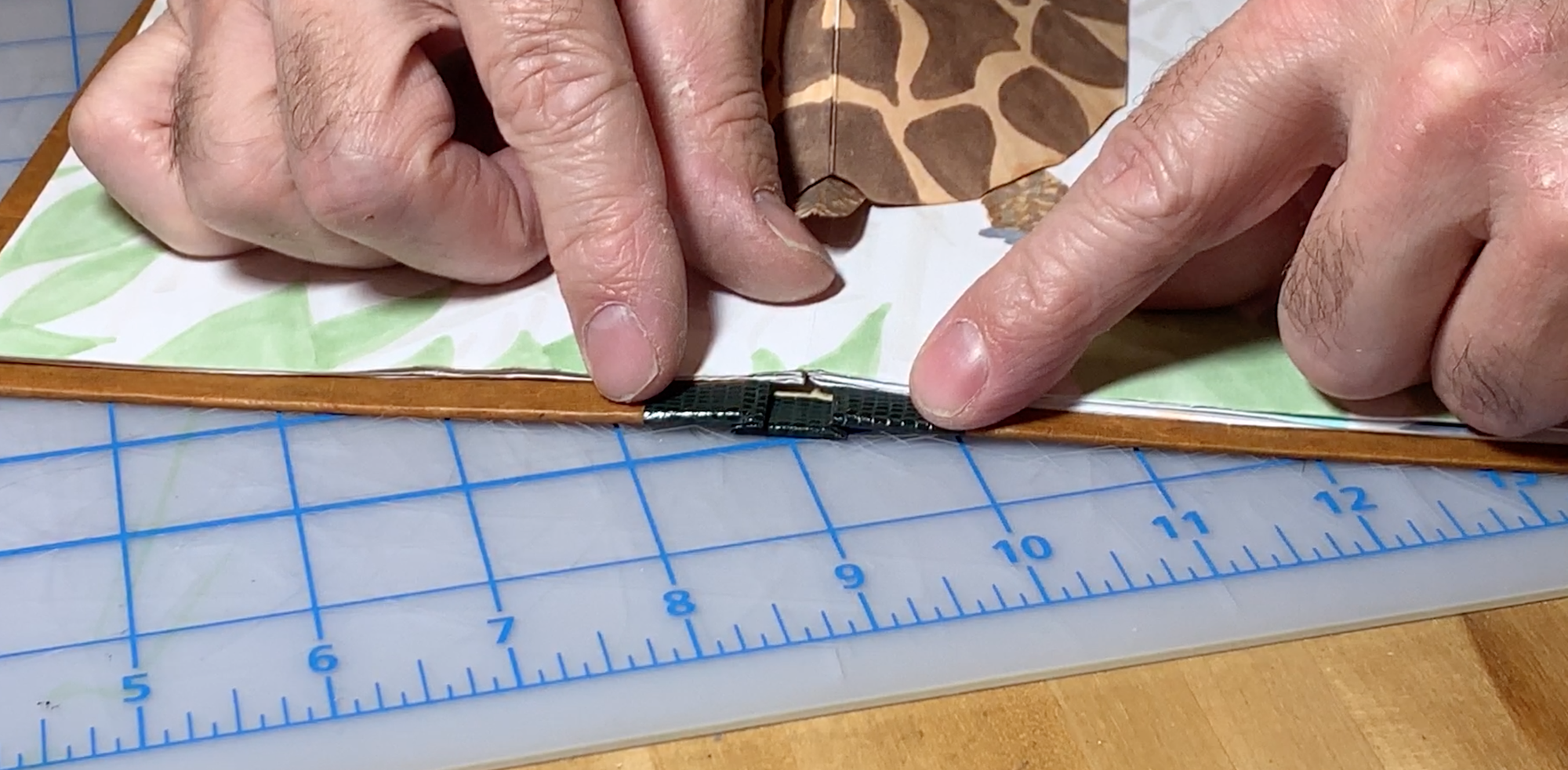
Binding a pop-up book requires special considerations, and is technique driven. It is the last step in creating a finished book and can ruin an otherwise brilliant project. It is imperative that you review classroom demonstrations and available videos, and understand the theory behind the practice. Logic and mathematics are involved.

Elements of a Good Book Binding
- Finished mechanical spreads must be assembled so the spine folds are accurately aligned.
- These spreads must be glued or adhered to one-another close to, but not up to, their spine folds. If they are glued too closely to the folds, the hinge may not flex enough. This is related to the overall bulkiness of the spreads and their mechanics. No two books or spreads are precisely alike.
- The spreads must also be glued or adhered at their front edges.
- The Cover Boards and Spine must be rigid material such as mat board or solid cardboard.
- The front and back boards should be sized so that its height is at least 1/2" longer than the spread's height. This allows for at least 1/4" of clearance between the top and bottom of the cover board and the spread edges, providing a clean appearance and protection.
- The cover boards' widths should allow the spread's front edges to have the same reveal as that of the top and bottom spread-to-cover reveal.
- The width of the cover boards is determined by taking the spread's width, adding the reveal amount, and then subtracting 1/4 of the spine width (the spine dimensions are described below).
- The spine height should be equal to the cover board height.
- The spine width should be equal to the cumulative thickness of all assembled and folded spreads, plus both cover boards, with the entire stack gently compressed to level-out.
- The outer cover material should be slick, clean, flexible, foldable, and glue-able. It should compliment the aesthetics of the book because a book is very often judged by its cover.
- The outer cover material actually forms the all-important hinge of the book.
- The outer cover material is sized large enough to accommodate all gaps, folds, and wraps, allowing the book's spreads to overlap it for an aesthetically clean appearance.
- For visual purposes, the spine and hinge area can be done with its own unique material color. This can either be added before the spreads are set in place, or after. If done after, it will also affix the spine at this time.
- After all calculations and measurements are accurately made, the cover boards and spine are glued to the outer cover material.
- The cover assembly must be accurately fitted to the spread assembly, and then one side of the page assembly is adhered to the cover assembly with glue or other adhesive. Then the other side is adhered in the same manner.
- A properly bound book will look beautiful and function flawlessly.