Visual Style Part B
Book Aesthetics, Theme, Technique, and Continuity
Your pop-ups must be artistic and visually interesting, taking the following into account:
- Silhouette - what are the shapes of your mechanisms? If you look only at the cut out shape of the paper, is it identifiable, or is it a lumpy, amorphous shape? If you're making a bush, lumpy and amorphous might be fine, but if you're making a person, the position of the limbs should make the silhouette recognizable. Take the animals above, for example. The shape of the ears, angles of the heads, and arm gestures would generally be readable regardless of the art painted on them.
- Pattern - For your art, are you using flat planes of color? Drawing or painting your own art? Collaging photographs, origami paper, or sheet music? Do you have a balance of small patterns, large patterns, and flat colors? What about the mechanisms themselves? Do you have repetitive elements to create a certain visual tone? Think about what repetition, symmetry, and asymmetry did to the visual impact in the TGF and lamp projects.
- Color - If you've taken color theory or 2D design, you will have a working knowledge of different styles of color scheme. If you're unsure where to start, watch the video on the Color page, and do a quick google images search for "color theory schemes." It is not required that you follow a scheme or even that you use any color at all, but it must be cohesive and consistent in a logical way.
- Volume and Scale - How big is it? Do your mechanisms and art fill the entire page effectively? Is it sufficiently three dimensional, or does the page feel kind of empty?
- Motion - How do the mechanisms move? Do they move swiftly or slowly? Does the motion reinforce the story of your illustration? For example, if you're making a butterfly, does the motion reflect the flapping of the wings? Or if you're making a creature with an open mouth, are you using opposing v-folds so it looks like the jaw is closing? Does the motion of the mechanism show kinetic storytelling?
Example 1
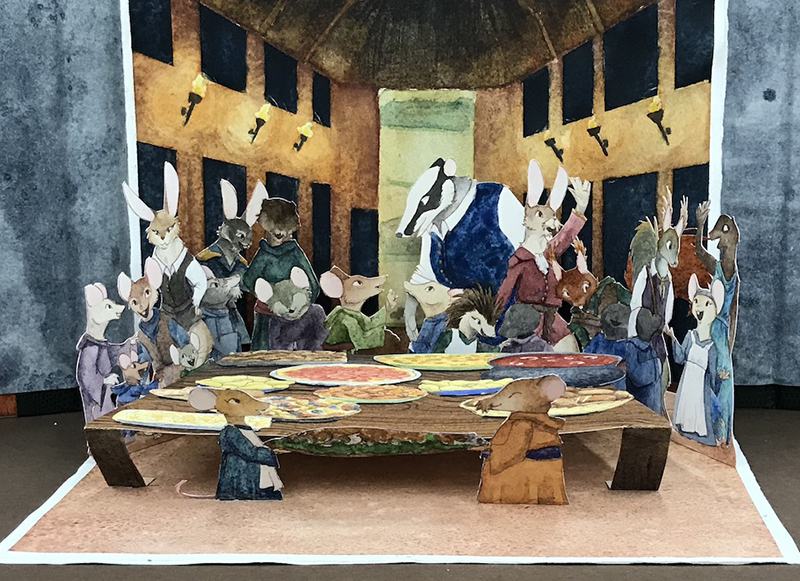
The pop-up above is an example of a stage view layout like the Peter and the Wolf pop-up shown in Visual Style Part A. The art is watercolors on hot-press watercolor paper, and Gates let the paper dry completely flat before she cut her art out so that it wouldn't curl or warp. This is a good example of the art filling the entire page, with very little blank space.
Example 2
Mushroom Pop-Up book by Ebba Wagner, Fall 2021
This beautiful book by Ebba Wagner really plays with pattern and value. She used multiple values of blue and red posca paint pens to create different levels of contrast. Her mechanisms are scaled well to both fit and fill the pages. She didn't quite hit the goal of three mechanisms per page and six unique mechanisms total, but the most notable "flaw" was that she didn't take into account all of the visible surfaces. The backs of mechanisms and the supports beneath them detract from the overall aesthetic when the eye is disrupted by the bright white of blank paper behind the pop-up mechanisms, especially since the art is so graphic and saturated.