Visual Style Part A
Visual style has to do with the overall look that you choose for your book. This includes the media you use, the placement of text if any, and continuity throughout. There are myriad unique styles; none of which is "the right way". Although visual style differs from one designer to another, successful books employ similar ideas of composition, proportion, placement, color choices and theme on every spread.
A visual style can be incredibly simple and clean, or grandiose and chaotic. It can: employ geometric or organic form, visual texture, utilize smooth gradients, be made of solid colors, be high contrast black and white or a single tone throughout. It can be made from photographic collaged imagery, painterly style, graphic line art, solid colored paper, or textured materials. Whatever theme you choose, continuity is the key to creating good visual style.
Laying out each spread in a consistent manner is a great way to lead the viewer through the book. If the book is meant to be opened from left to right and viewed like a picture book, then every spread should follow suit. However, some books are to be viewed as a stage, and opened from the end, with each spread flipped away from you. Or in this stage concept the spreads can be flipped towards the viewer, one piled on top of the other. The design can also be considered "in-the-round" where there is no front or back view. In this case, the spread lies open and the book is rotated about to view the constructions.
Another consideration is visual perspective. The in-the-round concept mentioned previously relies on objects being sculpturally proportioned so that there is no foreshortening and contains no illusion of depth. Instead, it contains elements that form their own natural foreshortening and depth because they are physically in space. A completely different approach is to force perspective into a scene and require viewers to see the book as though they are looking at a 3-dimensional picture; a relief sculpture with foreground, background and atmospheric perspective. In this case, there may be distant flattened skies or landscapes behind the main objects. Yet another approach is to make the images intimate, where the viewer feels as though they have entered a hemmed-in world. This can allow the designer to make pictorial scenes that have no backgrounds at all, and are all about the objects and their negative spaces.
Visual style is an essential component of the project. Choose a style that you feel good about using throughout your book.
Example 1
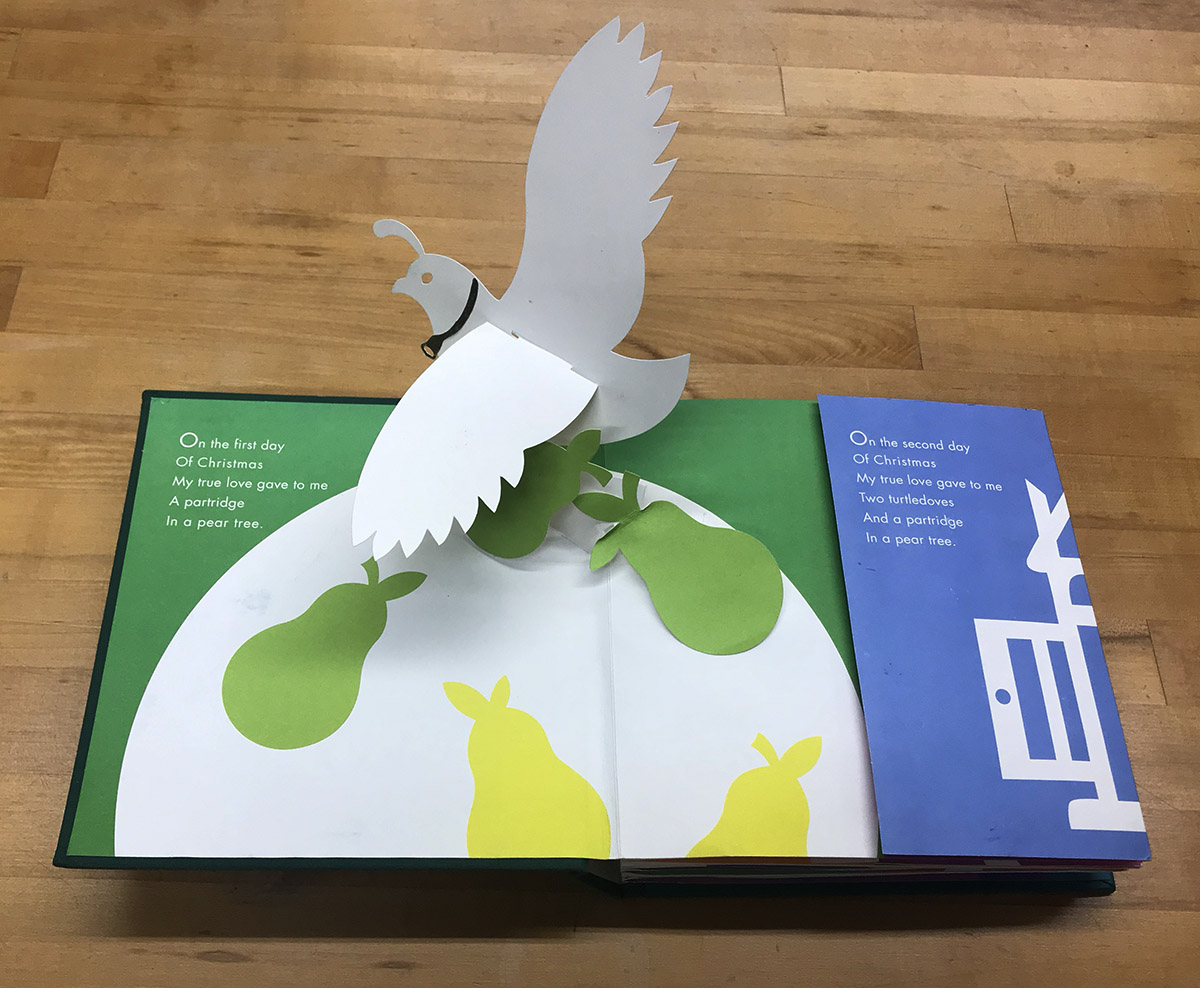
This book makes use of solid, matte colors and white to make a statement. The artwork is crisp. There is a secondary flap to the right on every spread. When opened, another pop-up is revealed. 12 days fits into 6 spreads! Text is white, and is placed over different solid colors throughout the book. The partridge explodes beyond the spread, breaking up the edge of the book. It is meant to be viewed straight-on.
Example 2
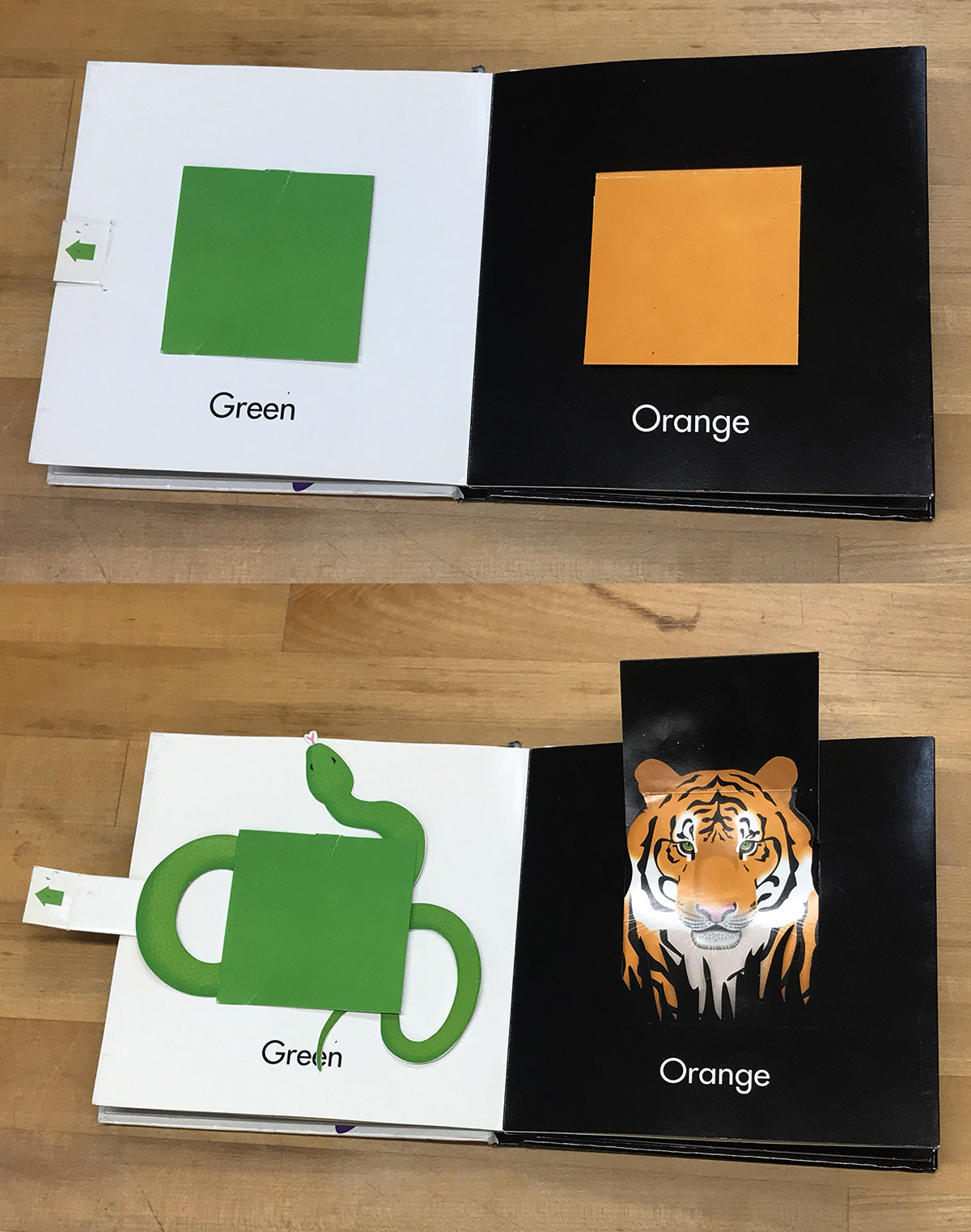
The theme is to split the spread into two pages, with white on the left and black on the right. Then on each page is a different colored square. The only text is the color name. Each square reveals a unique animal related to the color, and uses a unique mechanism. The final page is a crescendo of all colors, with beautiful fish popping out everywhere!
Example 3
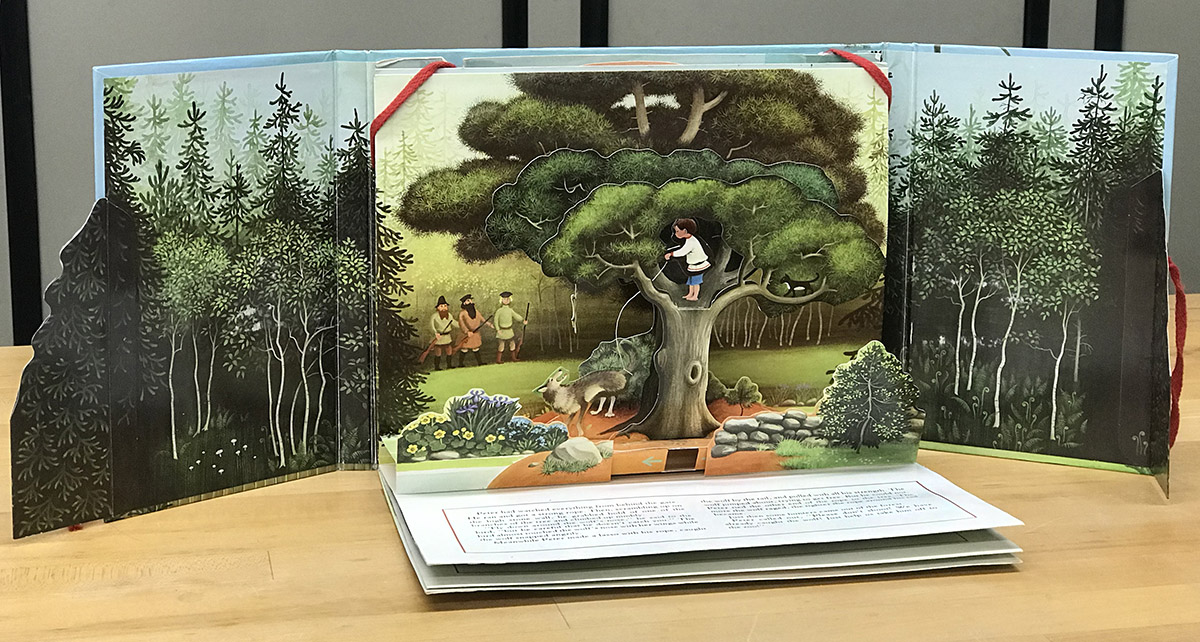
Each spread is presented like a stage in a play, laid one atop the other. There is plenty of text, but it is cleverly set in a rectangle at the foot of each scene. The mechanics utilize a sliding box in the center bottom of the tree. Stick a finger into the opening and slide to the left to see the boy pull the poor wolf by the tail with a rope. The wolf jumps in reaction. In the end, the wolf lives in a zoo. The original art medium appears to be paint, possibly watercolor. There is a relief-sculpture aesthetic throughout, set among a flattened landscape and sky.