Cut and Fold Versus Assembly
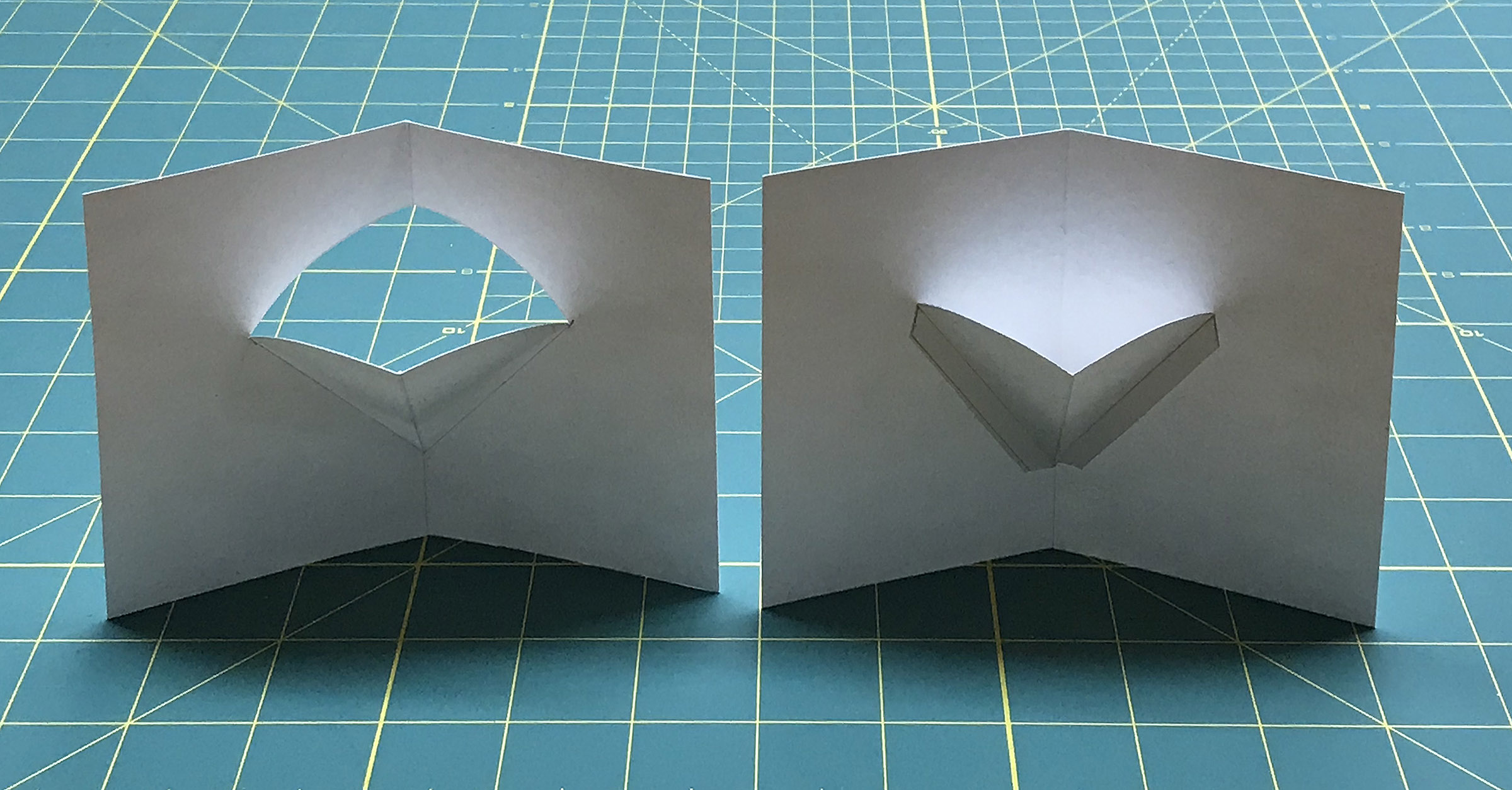
To the left, a Cut and Fold example. To the right, Assemble. Both are v-folds of the same size, though appearance and technique differ.
There are two distinct approaches to paper engineering: CUT AND FOLD and ASSEMBLY.
Both are capable of yielding great results, but processes and appearances differ. At first glance, they may look very similar. In the example above, both are v-folds with the same dimensions and position on the spread.
On the left is the Cut and Fold method, which requires no glue or added paper. It is clean, and can be machine die-cut and simply creased into final form. It does, however, have major limitations. For one, there is a visible opening were the paper is gapped. This can be unsightly or visually distracting, and makes the left portion of the spread fold weak. Note that there is no paper removed in this example; rather, the gap is the result of the outwardly folded paper arcing to the right. Another issue with Cut and Fold is that it relies on the original paper area for the entirety of the design, and if the outward fold is accidentally inverted, the spread will appear flat. This type of design cannot be opened 180 degrees, or the 3-dimensional form will disappear.
On the right is the Assembly technique. There are two paper elements assembled together using glue. The added piece – the v-fold – has tabs that create the necessary mechanical connection between the two pieces, as well as the hinge required for folding. Although in this example the tabs are placed outward of the v-fold, this is not usually desired. It was done here purely for clarity. It is better to have the tabs glued inward for three reasons. Firstly, they become hidden; secondly, when folded closed, they flatten out thinner; and finally, when closed, they will not act as a spring to open the book. When the tabs are glued outward as above, the folded spread bulks up and doesn't want to stay closed. An advantage of Assembly is that complete artwork can be placed behind objects. Further, the structure is noticeably solid and physically strong. It is possible to create a form that protrudes from the spread even when it is opened 180 degrees. It is also possible to assemble the same v-fold element to the spread at different pitches if desired, changing its height and appearance. Disadvantages include having to create multiple parts, and the possibility of improper assembly, ruining otherwise well executed artwork.
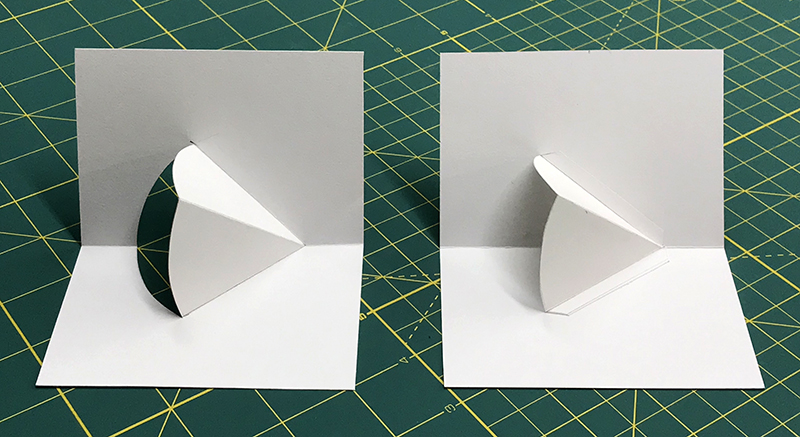
Although both methods are well established and used by designers regularly, Cut and Fold is more of an economical process while Assembly requires more resources. Cut and Fold can be treated like a puzzle to solve. It can be beautiful and abstract when shadows and light are added into the mix. Negative Space is an extremely important element in good Cut and Fold. In fact, from a sculptural standpoint, Cut and Fold creates visual complexity through simple form. On the other hand, most high quality pop-up books utilize Assembly because it is stronger and fits better with the pictorial concept of a story book.
Bottom line: Cut and Fold is best as a stand-alone sculptural element. Assembly is best as a pictorial enhancement.