Text As a Visual Element
Text on a Spread
Most picture books contain text. There is no correct amount of text to use, but below are some guidelines that can help you determine how words can be seamlessly integrated into your book. Text is not required for this project – it is up to you to decide if it is an important element of your book.
Consider balancing the amount of text to be roughly equal on each spread. Consider how much text is actually necessary to communicate your idea. You will find that the visual power of the pop-up mechanics can overwhelm too much text. People may simply skip over the text if it feels burdensome to read through.
The location of text on a spread is determined by compositional considerations. You may wish to designate the same location on every spread for your text, or you may design a space within each composition to accommodate text in different places. In the latter case, it may be within the open sky, on the flat surface of a table, etc. Just as you don't want to photograph your artwork with a busy background, you also don't want to put text over very busy art that will make it difficult to read the words. The text can be integrated into the visual scene so that it wraps around the art like in the example above, or placed in a rectangular alignments outside of the scene such as in the book example below. Sometimes the art behind the words will be fainter and desaturated, or the text will be contained within a border. Either way, it is important to make words readable and clear, without compromising the artistic aspects of the spread.
Example 1
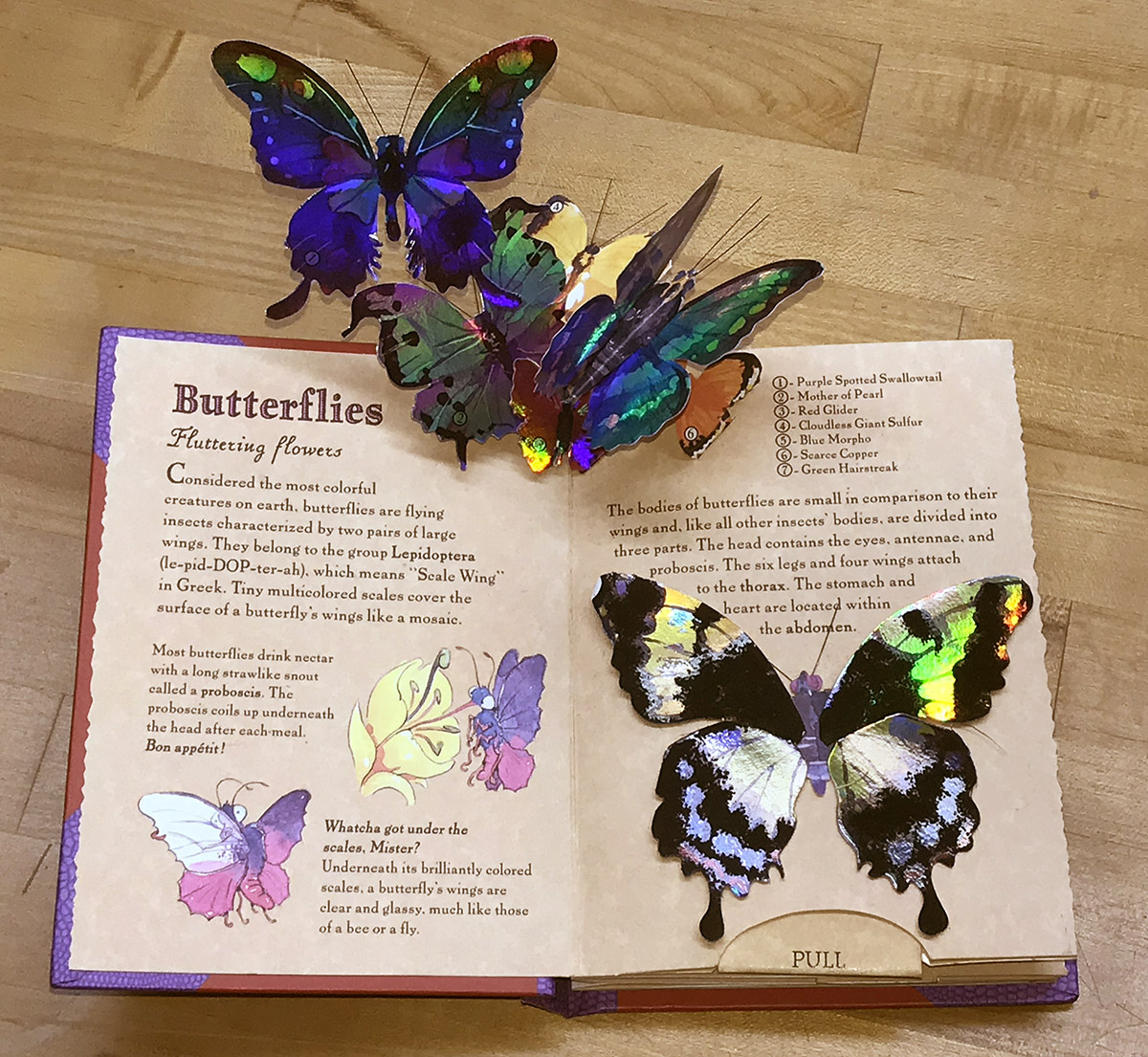
Text is very important in this book. It is laid out carefully to flow among the pop-ups and has a scientific yet friendly feel about it, as though it is a field journal. On each spread to the upper left is a title; in this case, pink-filled "Butterflies". On the next spread is green-filled "Moths", etc. Overprinted shimmery holographic paper gives the butterflies changing colors. Notice how the numbered list corresponds to specific butterflies in the upper scene.
Methods of using Text
There are many approaches to physically integrating text into your book. You can hand-write it. You can use an old fashioned typewriter on the actual spread material. You can digitally print either directly on the spread material or on a separate paper that is collaged in place. Or you can even find or print rub-on lettering. The text problem requires creative solutions.
Typography
Font, scale, color, and weight are visual decisions that affect your composition. Are the words shaped appropriately for the visual style of your artwork? Are they readable and balanced against the pictorial elements, or are they distracting or even difficult to read? Is there a consistent typographic style from spread-to-spread, or does each spread have a different style to match its illustration?
You can use digital typesetting, or you can write your text by hand. If written by hand, the text must be clear, legible, and stylistically appropriate.
Example 2
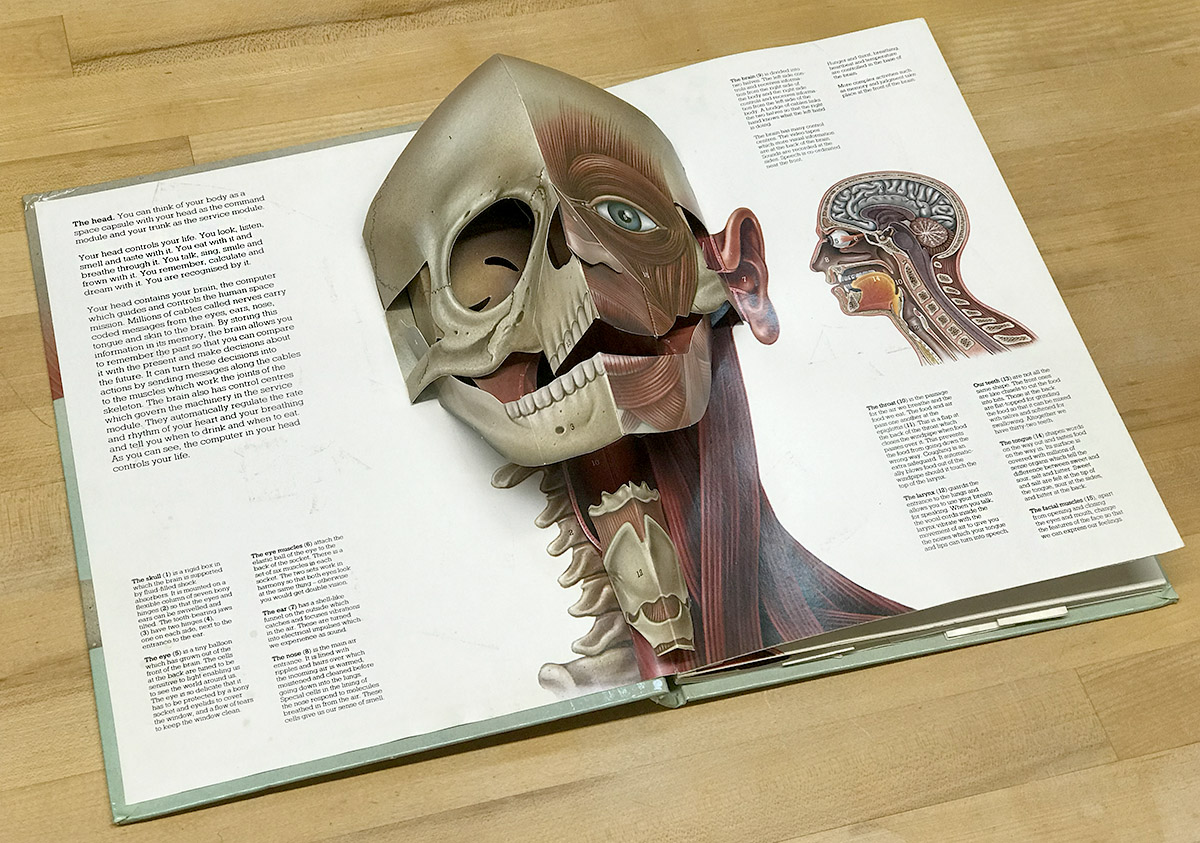
Illustrations and mechanisms by David Pelham. This book is science-based and very descriptive. Every spread is filled with illustration and text to go with it. The layout is very matter-of-fact, with black text on a white background. The pop-ups are dominant, set within a large amount of white space, reminiscent of a textbook. Text on the upper left page is larger, and describes the main theme of that spread. All other text supports numbered details in the illustrations.
Further information regarding the subject of text and typography is beyond the scope of this class. It is up to you to do research and to apply your newfound knowledge to your book layout.
Useful Links
https://en.wikipedia.org/wiki/Typography – An overview of typography.
https://fontsinuse.com – Examples of creative font use and identification.
https://www.google.com/search?q=book+design+blogs – A general search for book design blogs.