Student Jewelry Examples
Anna Leah Bodo
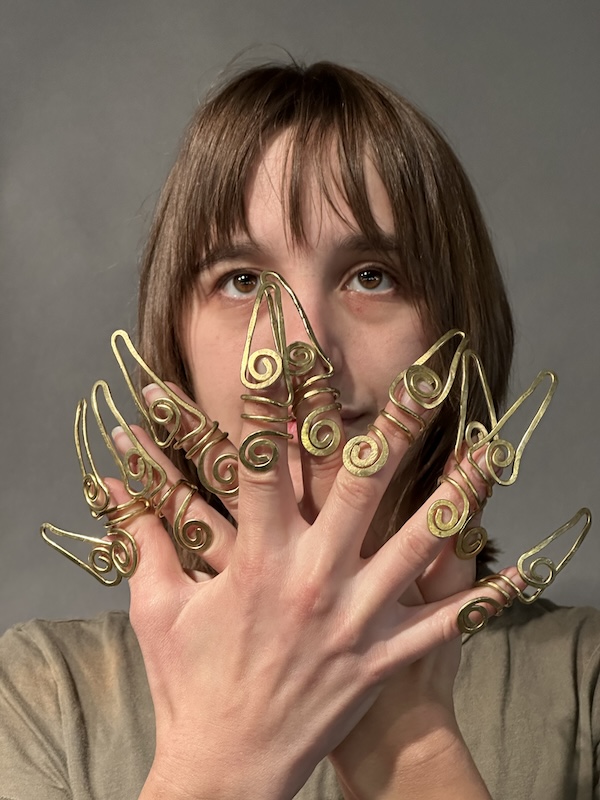
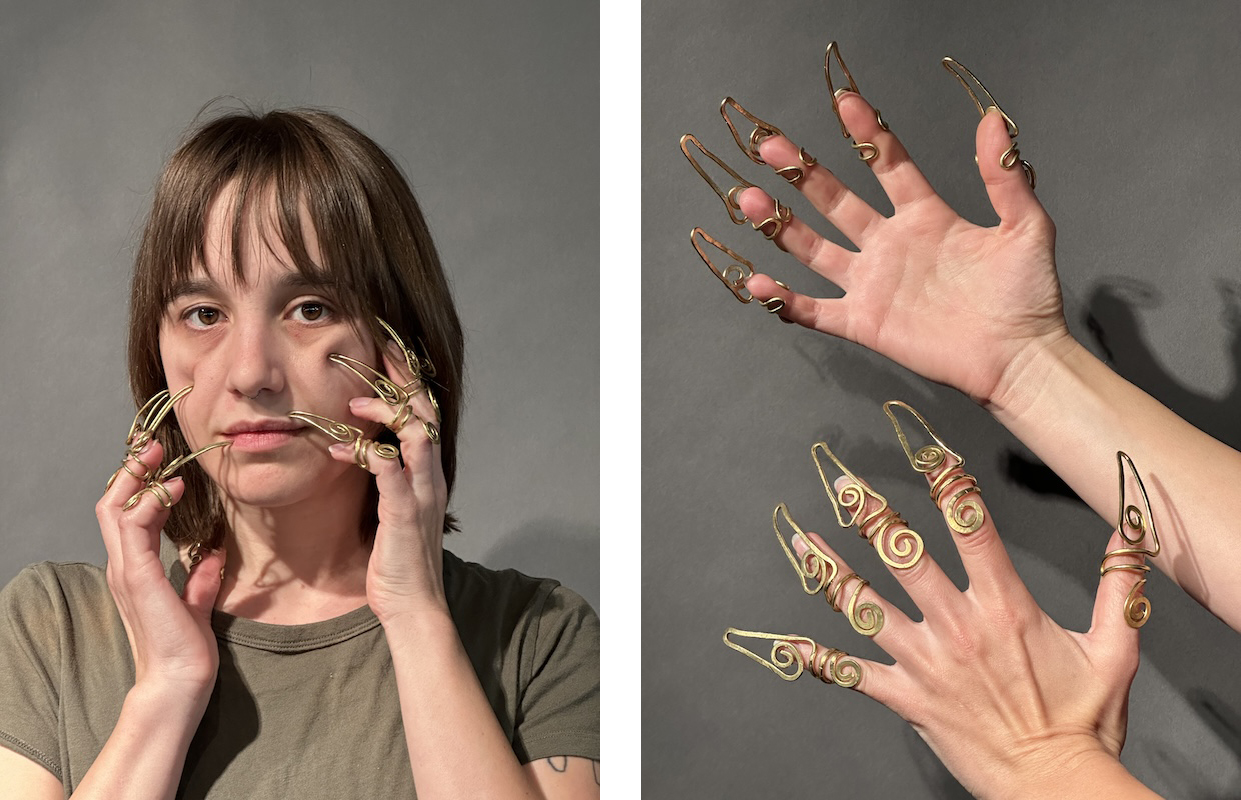
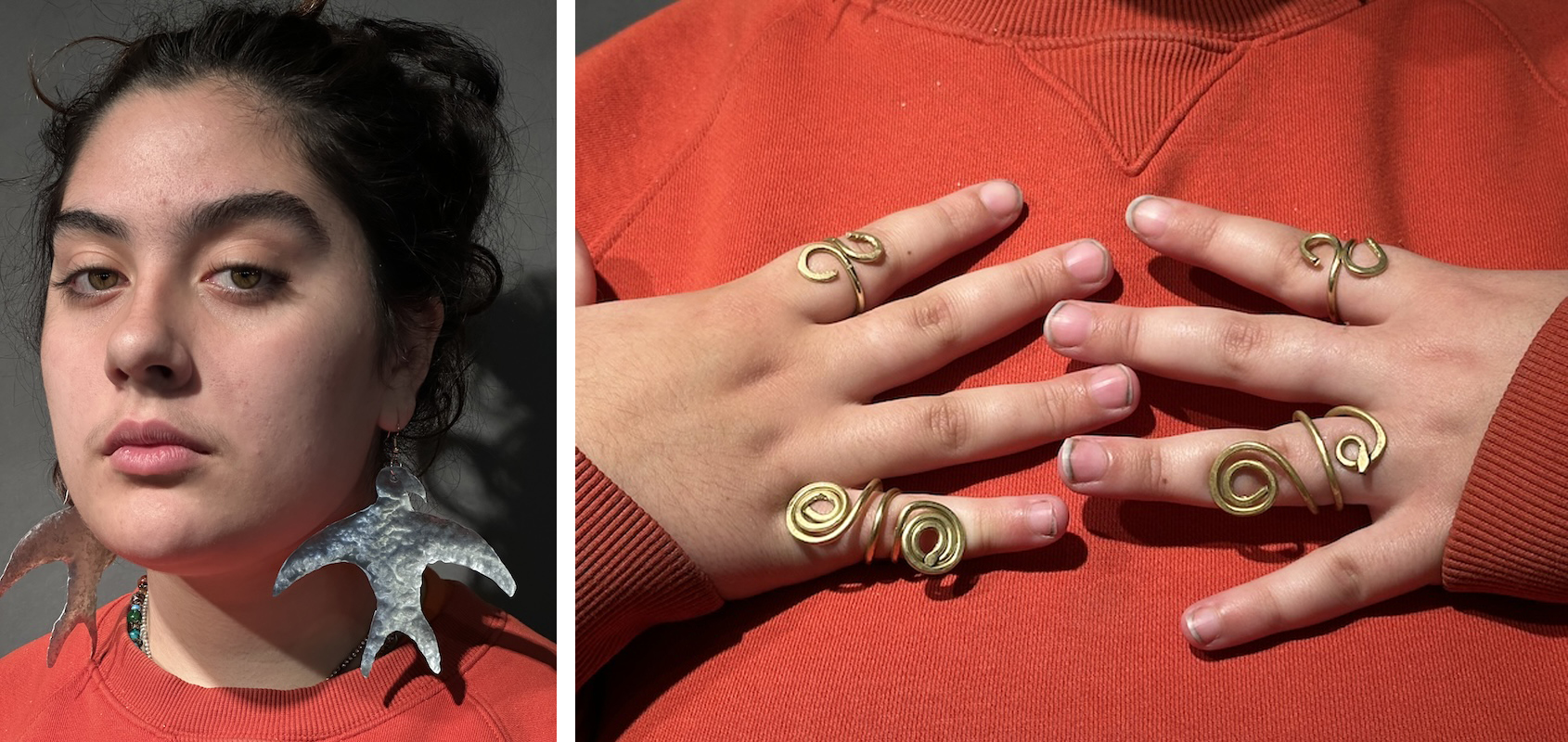
On this page are examples of jewelry - or more appropriately wearable art - made by students responding to the Calder Project. Some demonstrate similar motifs, media, and methods utilized by Calder, and others do not. It is important to define how work was done within and outside of the given scope and rules of the assignment. Above is the work of Anna Leigh Bodo, who used brass wire to create finger-worn pieces that are reminiscent of Calder, yet entirely unique. This is a creative solution to the project that both references its concepts, and explores a new avenue. Alexander Calder would not have created pieces that completely immobilized the wearer, but this feature makes Anna Leigh's project visually powerful. Reminiscent of Calder are the hammered spirals. Below are two more photos of this work.
Sophia Holt
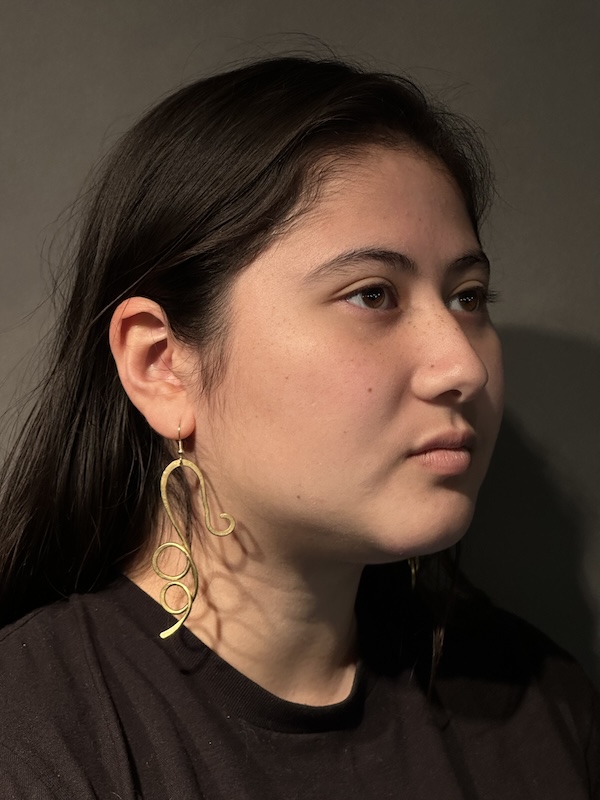
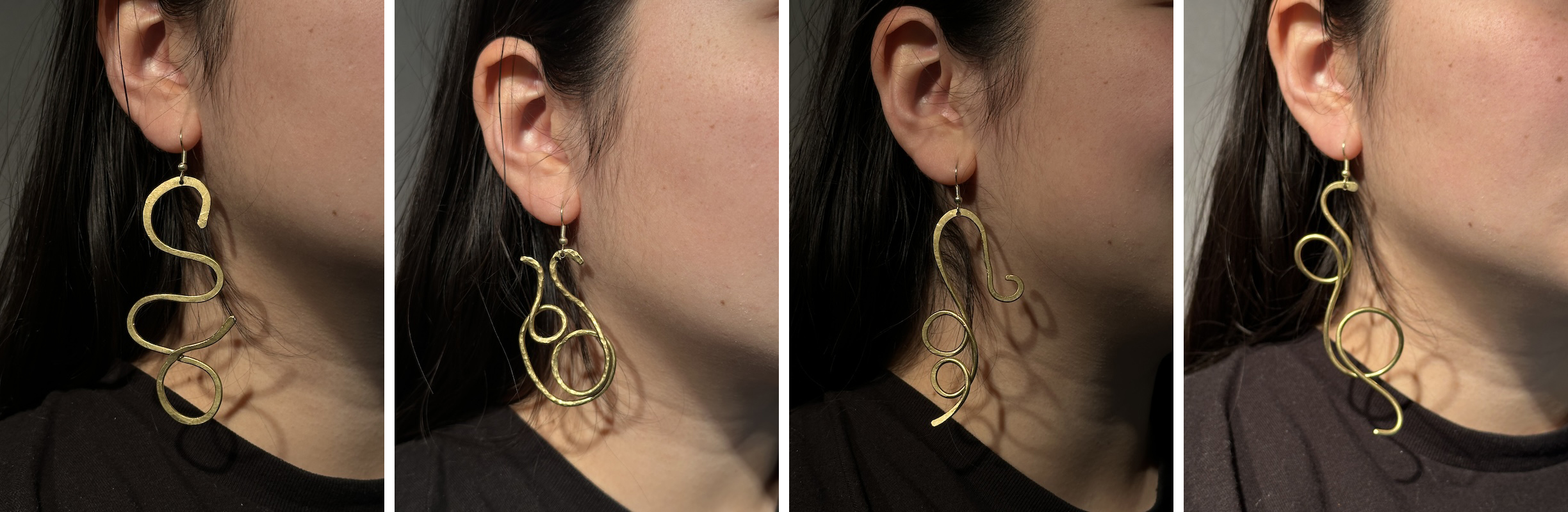
Sophia Holt made small pairs of earrings that gave her time to create four sets. Some sets are fully hammered, while others use the raw brass wire almost directly off the spool. They borrow from Calder's meandering loops. Each set comprises two earrings that are mirror images of one-another. All four pairs share a common meandering and overlapping visual theme but each set explores a variation on that theme; different textures, changes to the loop pattern, and surface finish. Calder would have most certainly altered the entirety of the wire in his work. Sophia did manipulate much of the wire in her pieces, but left some parts untouched. All of them utilize store bought hypoallergenic piercings. These are looped through holes drilled in the brass. When piercing through skin, such as in the ears, it is wise to use the appropriate type of metal.
Amaya Lunibos Hartard
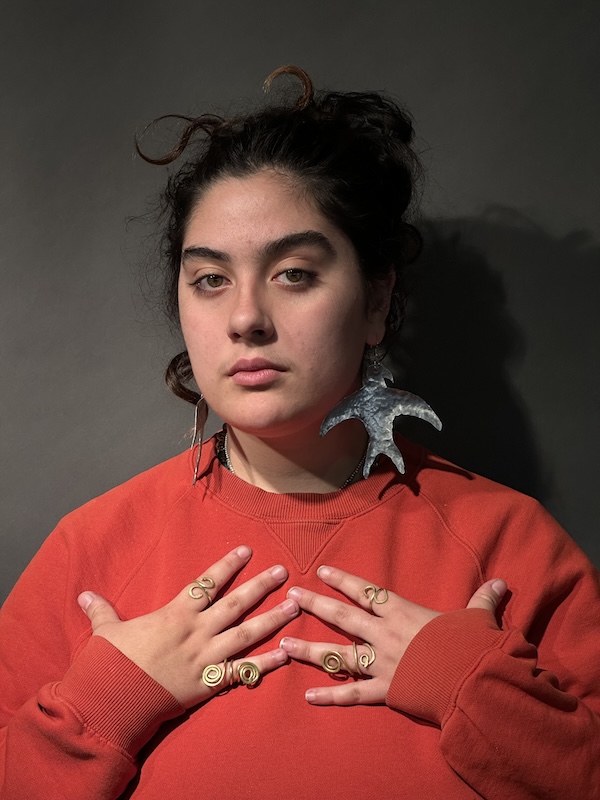
Above are pieces by Amaya Lounibos Hartard that incorporate lightweight aluminum sheet metal for the earrings - integrated with store-bought piercings - and hammered brass wire made into rings. The rings apply thematic elements similar to Calder, including the characteristic spirals. The large area of the earrings makes aluminum a good choice because they are very lightweight, Aluminum cannot be used for a piercing, as this material would adversely react with the body. Although the bird forms are not necessarily elements that Calder would have used in his jewelry, they certainly might be referenced in his early non-jewelry works. The bird forms are hammered into concavity through a technique of stretching and shrinking the metal. Stretching is thinning out the metal by hammering or compressing, and shrinking is thickening the metal by hammering in a specific way that reduces the length of the sheet's perimeter, and domes the metal.
Grace Moore
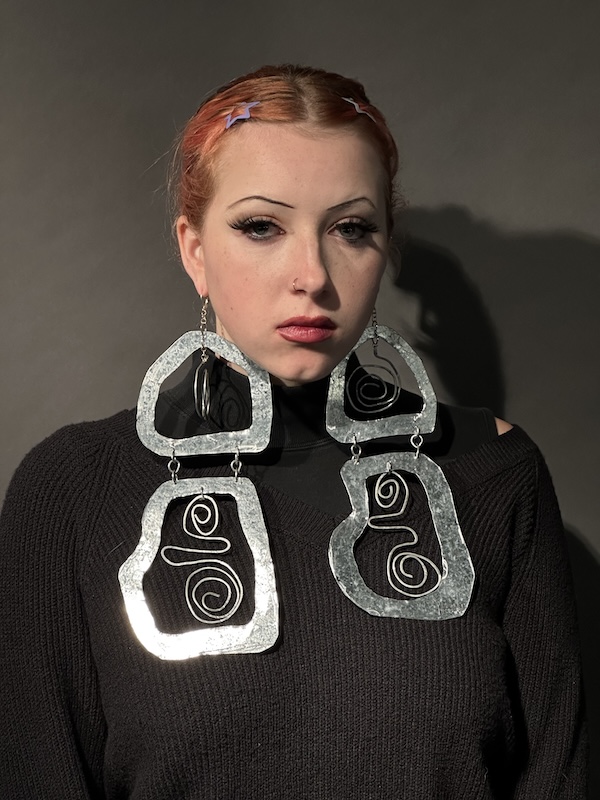
The earrings created by Grace Moore are a statement piece, that clearly shows how the body becomes a canvas for the work. Presented here against a dark background and sweater, they luminesce via reflection. These pieces are unusual for several reasons. First is that they are very large. Second, they are very heavy. Third, the galvanized components have relatively sharp edges, so care must be taken to avoid injury. Luckily, the wire elements are made from lightweight aluminum to offset the steel's weight. Certainly these works of wearable art could not be worn for long periods of time. The hand-wrought appearance is accentuated by the organic nature of the hand cut sheet's edges. Note that the spiraling wire forms are suspended in the middle of the holes, and held by one loop each. This allows the spirals to move loosely as in a mobile, so they can dynamically change their relationship to the framed space - as can be seen occurring in the left upper element. Galvanizing is a process of protecting steel from oxidation (rust) by zinc plating.
Weight-wise, aluminum is lightweight for a metal; it weighs about 168 pounds per cubic foot. Zinc weighs about 445 pounds per cubic foot. Steel weighs about 490 pounds, and brass is approximately 536 pounds for the same volume. If Grace's piece was made from brass of the same gauges as she used for the steel and aluminum, the earrings would be substantially heavier. On the other hand, they could have been made entirely from aluminum - except for the piercings - and been much lighter overall.
Jeremy Kindle
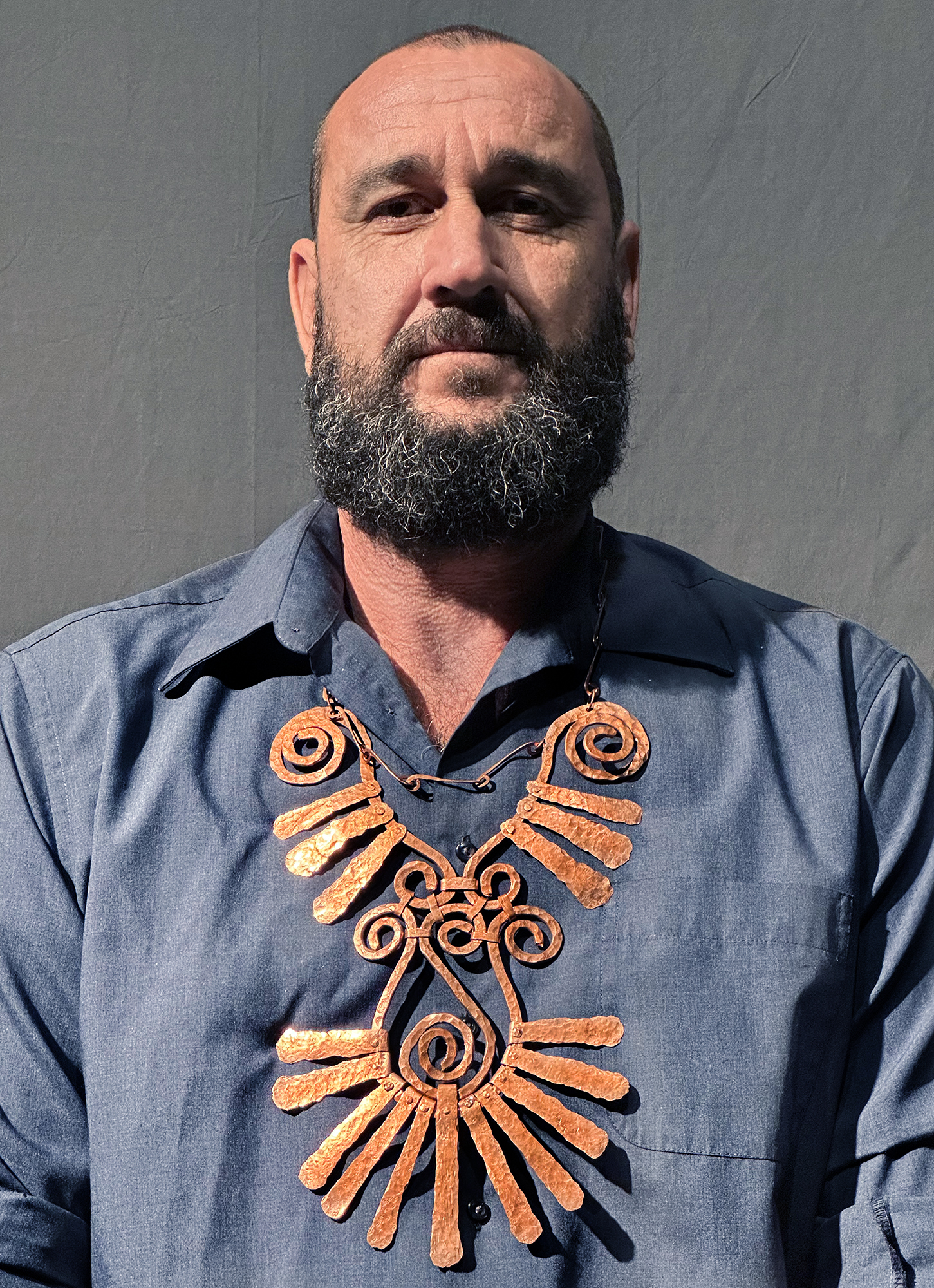
Jeremy Kindle used copper wire to create a large necklace, and a set of rings. He hammered and riveted the feather-like pieces, and used flattened wire to make bands that linked the spirals together. The rivets serve to lock the feathers into position so they radiate out along the arc they are attached to. Originally, Jeremy tried to affix the feather shapes only by bending the copper over the arch piece, but found that they did not stay aligned properly, so he added the rivets. For the necklace he used Calder-related forms assembled into a complex motif of his own design. The scale of the neckalce makes this piece dramatic and a showpiece. Jeremy is quite tall, and this piece was created to fit his torso. The flattened chain links were made from small-gauge copper wire.
Jeremy also created a set of rings for both hands that comliment the necklace. They are small, and against skin color, so they could not compete with the bold presentation of the necklace against his blue shirt. The rings are beautiful in ther own right, and would be noticable if worn on their own.
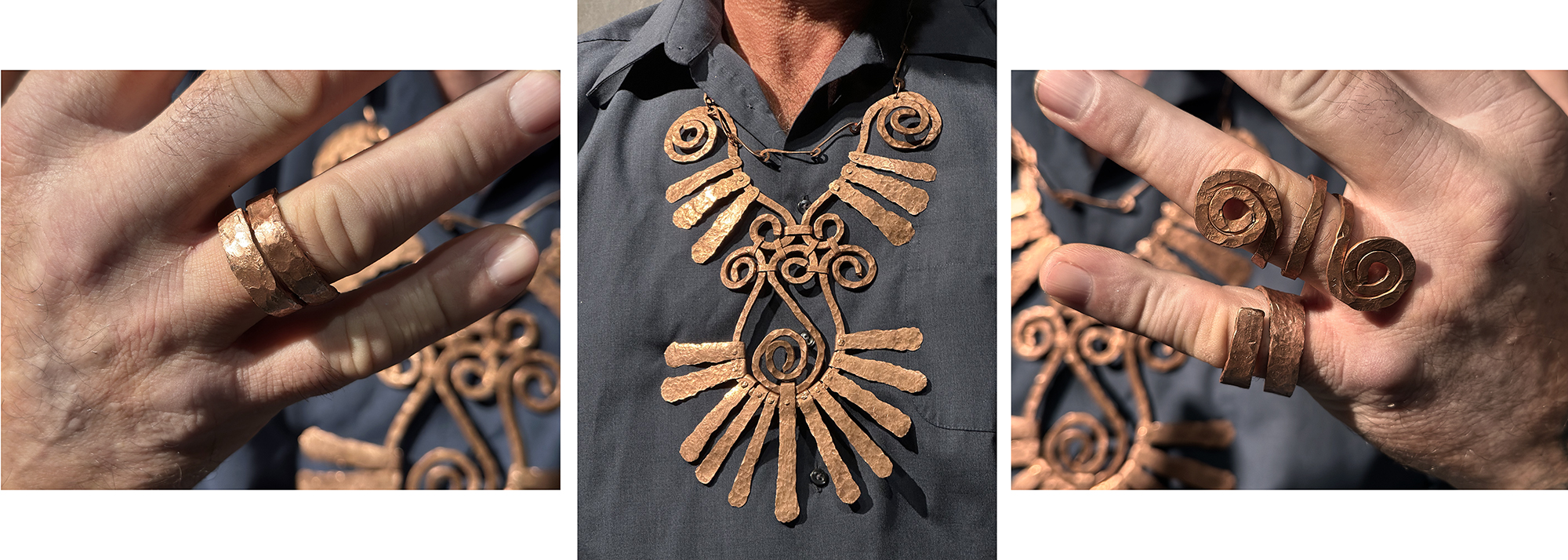
Gabby Samii
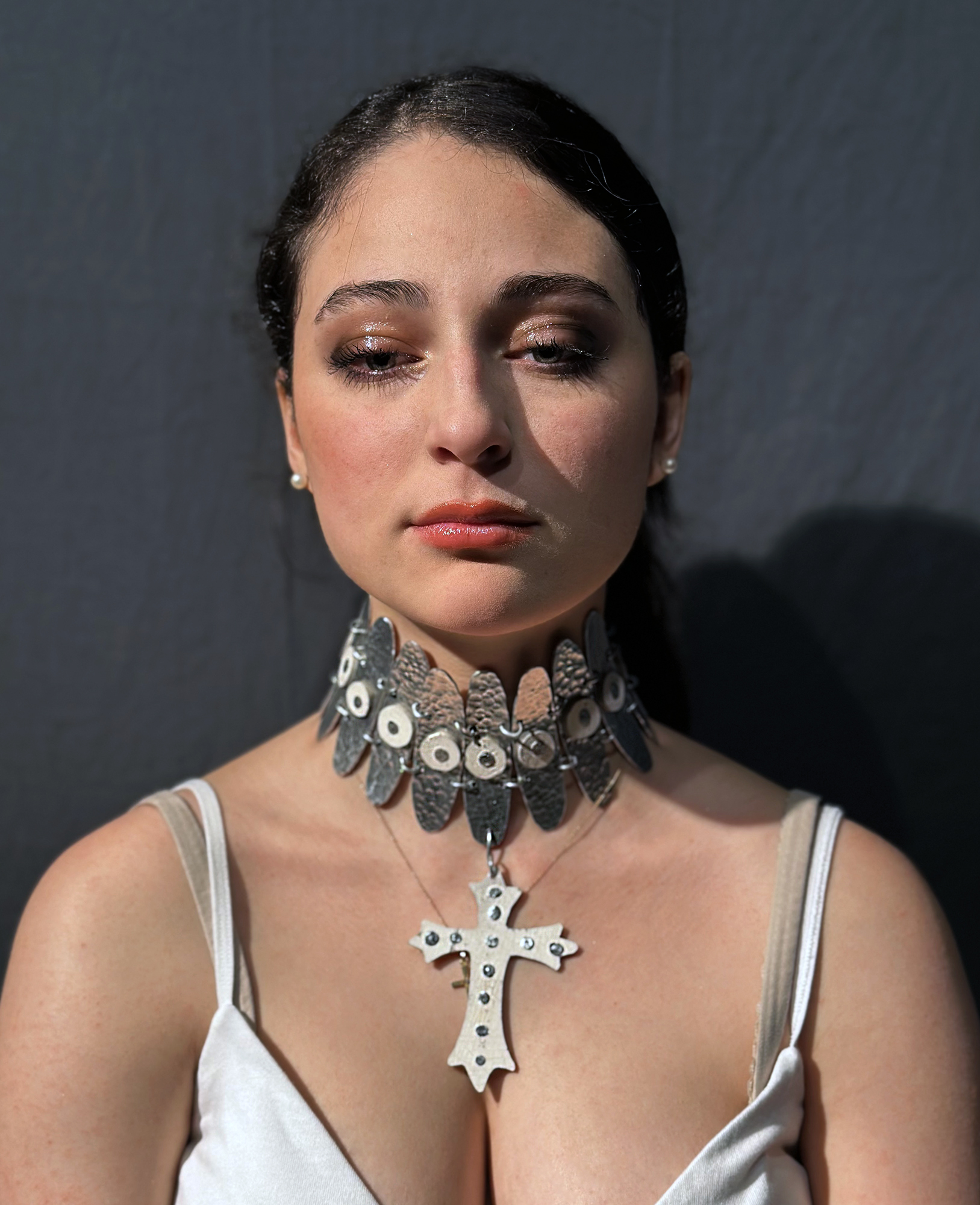
Although Alexander Calder would not have used such a recognizable symbol in his jewelry, Gabby Samii wanted to employ the cross because this form is one of her favorites. She made the white elements from a piece of salvaged boat hull found on the beach at Goat Rock along the Pacific Coast. This fiberglass and resin material was cut using a jeweler's saw, and hand filed to shape. The patina formed on this material reveals its journey from a fisherman's boat, to wreakage, to a sand-and-wave beaten relic, tossed to shore. Each button-like disk is irregularly hewn into a natural shape. The rivets throughout are made from aluminum armature wire. The loops are steel. Each collar piece was cut and then hammered from a sheet of nearly pure aluminum.
The collar compliments the cross both in material and visual strength. This combination creates an art piece that presents strongly against bare skin. The collar is custom sized for Gabby's neck and is restrictive to where it may be difficult to bend her head down. The curved shape of each collar piece is surf-board/boat-like, harking to the origins of the found-object material. The artist enjoys the cross as a form purely on an aesthetic level. Out of context, artworks are viewed and interpreted through the eye of the beholder, and in the way that myths are created, one may interpret a hidden theme here to Christ's relationhip to fisherman.

Shane Short

Shane Short created a set of four pieces for this project: a necklace, a crown, and two bracelets. This set is made from hammered aluminum armature wire that was recycled from painted sculptures made the previous year by students who left their work behind. He scraped and hammered the aluminum into a rough, natural texture. The copper elements came from used electrical wire, stripped from a twisted bundle. Shane worked entirely from found material, and turned this into highly-worked raw metal forms. His crown is atypical in the collection of student works, and when critiqued, he revealed that the shade element that hangs over his eyes is reminiscent of headdresses worn by indigenous Pomo people. Pomo are endemic to the region, and have a strong cultural signifigance. They used natural found materials in highly skilled ways, especially in their miniature, water-tight basket weaving. Shane is part Pomo, part Northern European. He wished to honor both in his work.
Originally, Shane presented his pieces against an entirely black background, as seen in the photo below, where his face was obscured. He did so in order to bring out its contrast. This looked almost armor-like, reminiscent of Shōgun. But when he wore it against his dark brown shirt and bare skin, the necklace and crown took on a more earthy appearance, relating strongly to his face, evoking a different kind of power.

Lia Furch
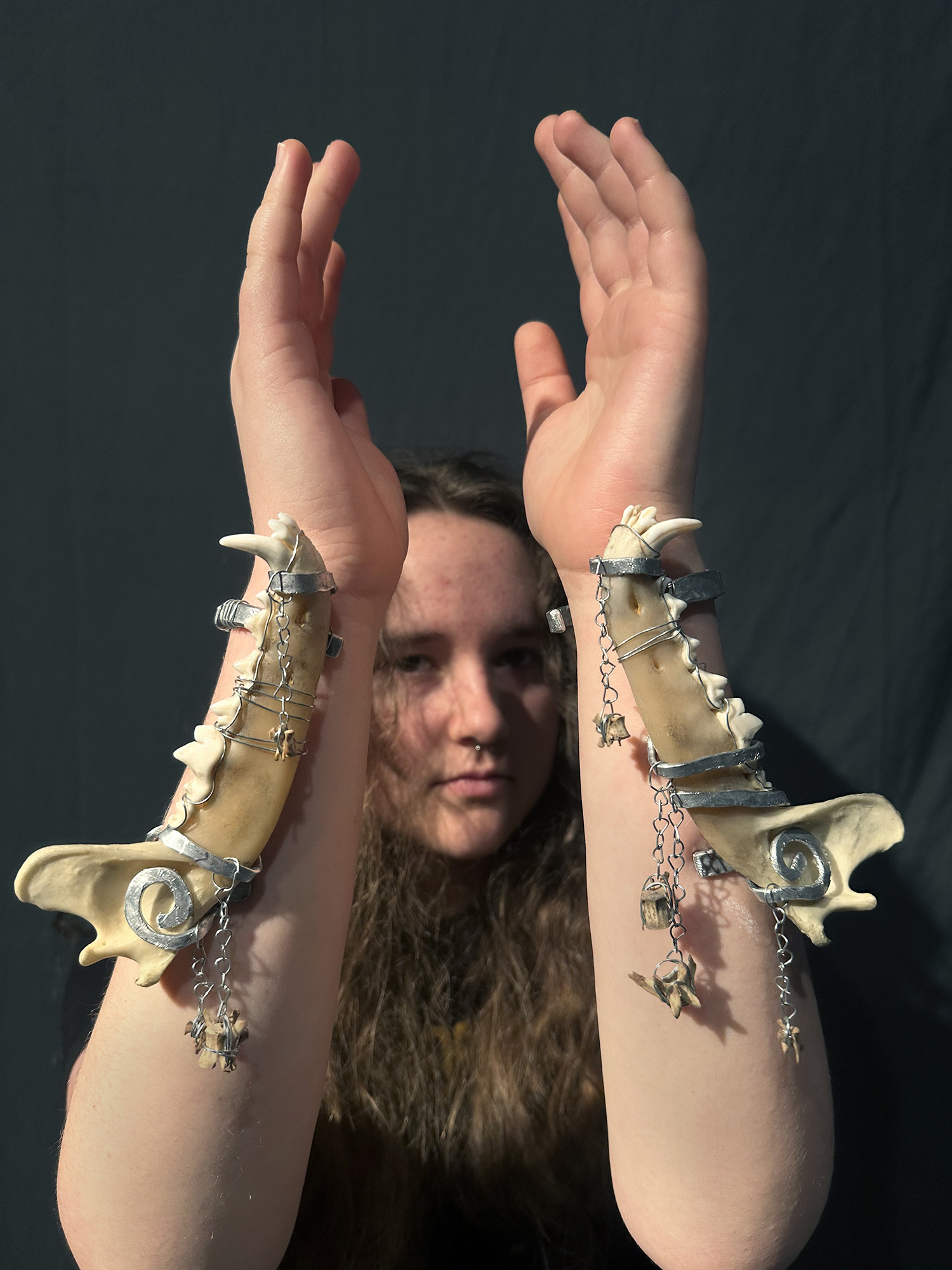
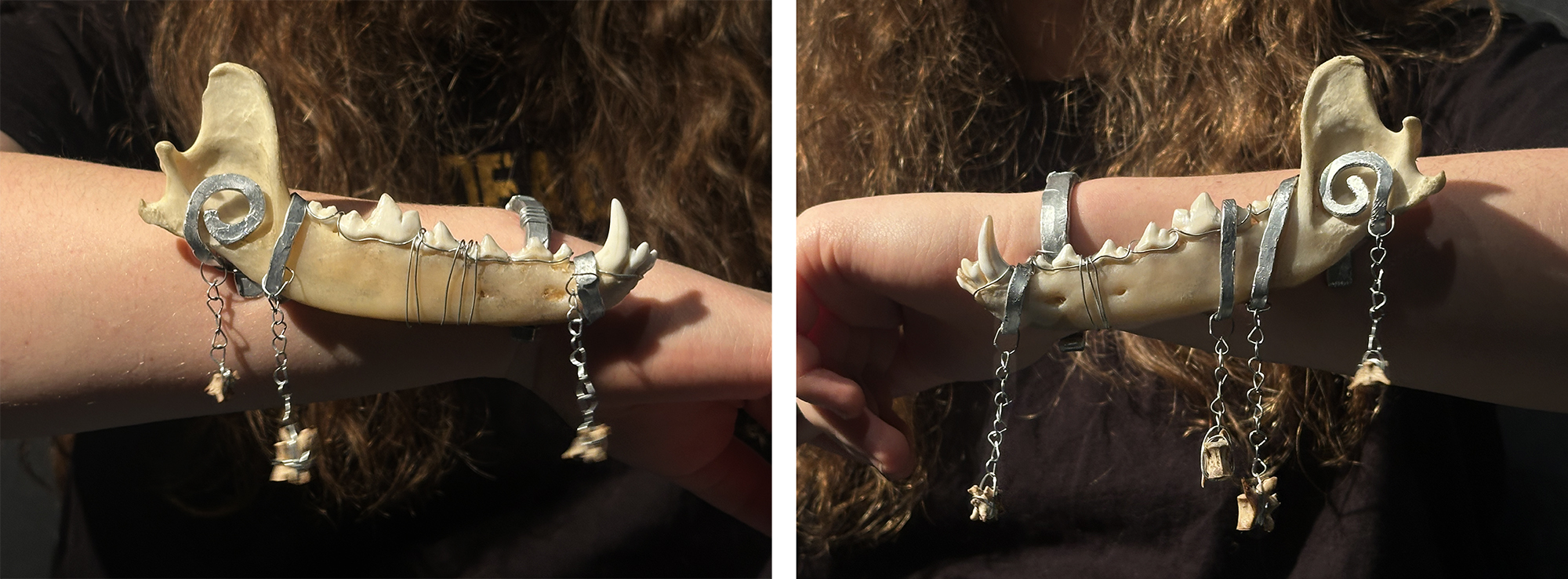
Made from aluminum, galvanized steel wire, a fox's jawbone, and tiny vertebra, Lia Furch's mirrored bracelets evoke a spirit animal vibe. Using such visually powerful elements in a work makes it impossible to ignore. The found animal bones have an ego of their own and cannot be mistaken for anything else. Calder would not have employed these objects in his work because of the strong ego. Instead, when he did use found objects, they were abstract in form. Driftwood and broken/worn glass were materials he worked with when his favorite material, metal, was in short supply.
The cold-formed, hand-made metal components in Lia's work, especially the hammered aluminum, fit well with the organic components. Although the long steel wire has not been fully transformed (it is still smooth, round wire), it has been sufficiently cut and fitted to take on an organic quality that supports the jawbone motif. The chain links are irregularly formed, which adds to their ancient, living appearance. When working with bone or other animal parts, care must be taken to assure no pathegens are present. Lia received these parts from a reputable source that cleansed and bleached the bones.
Lea Fabian-Davies
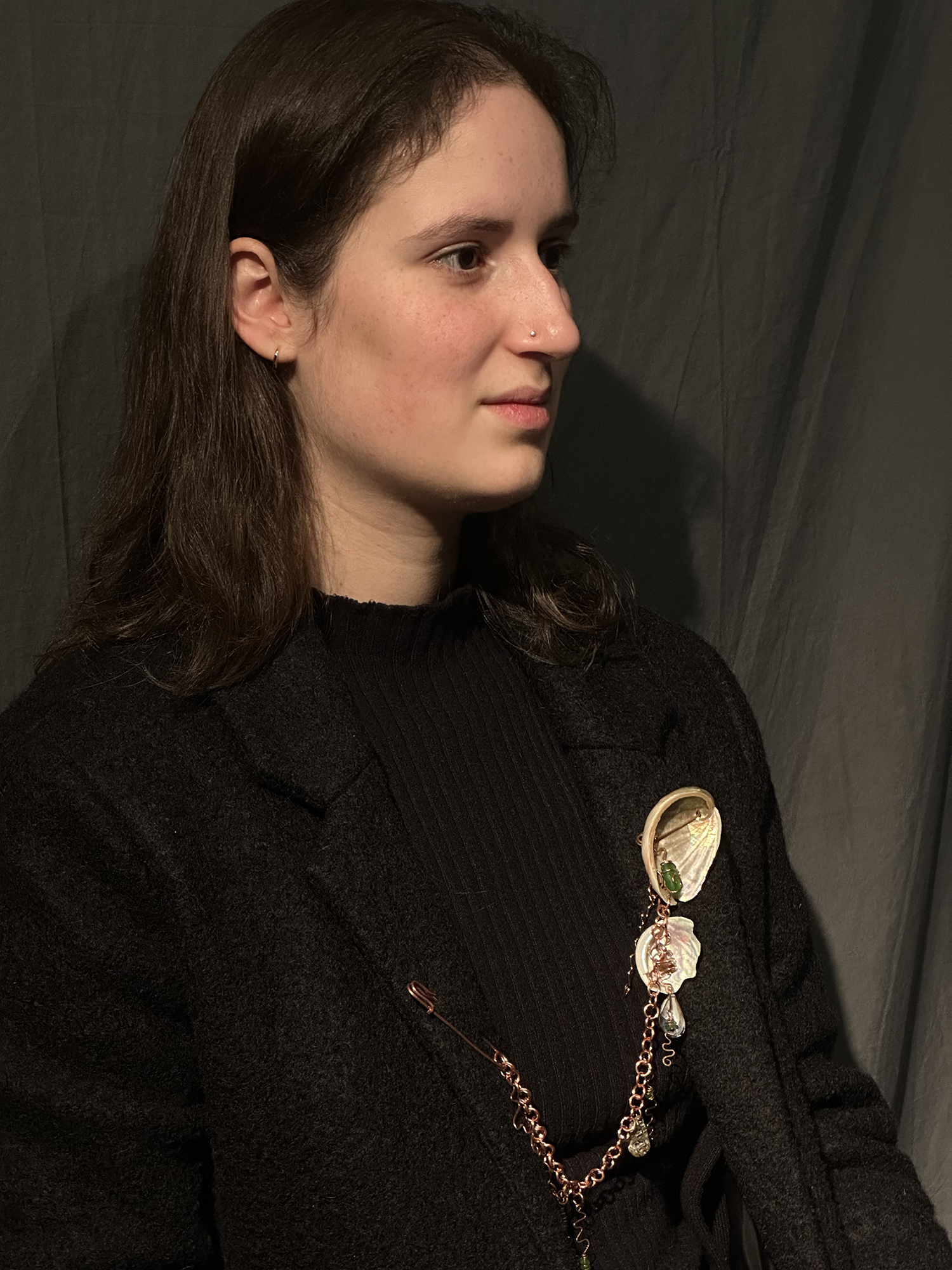
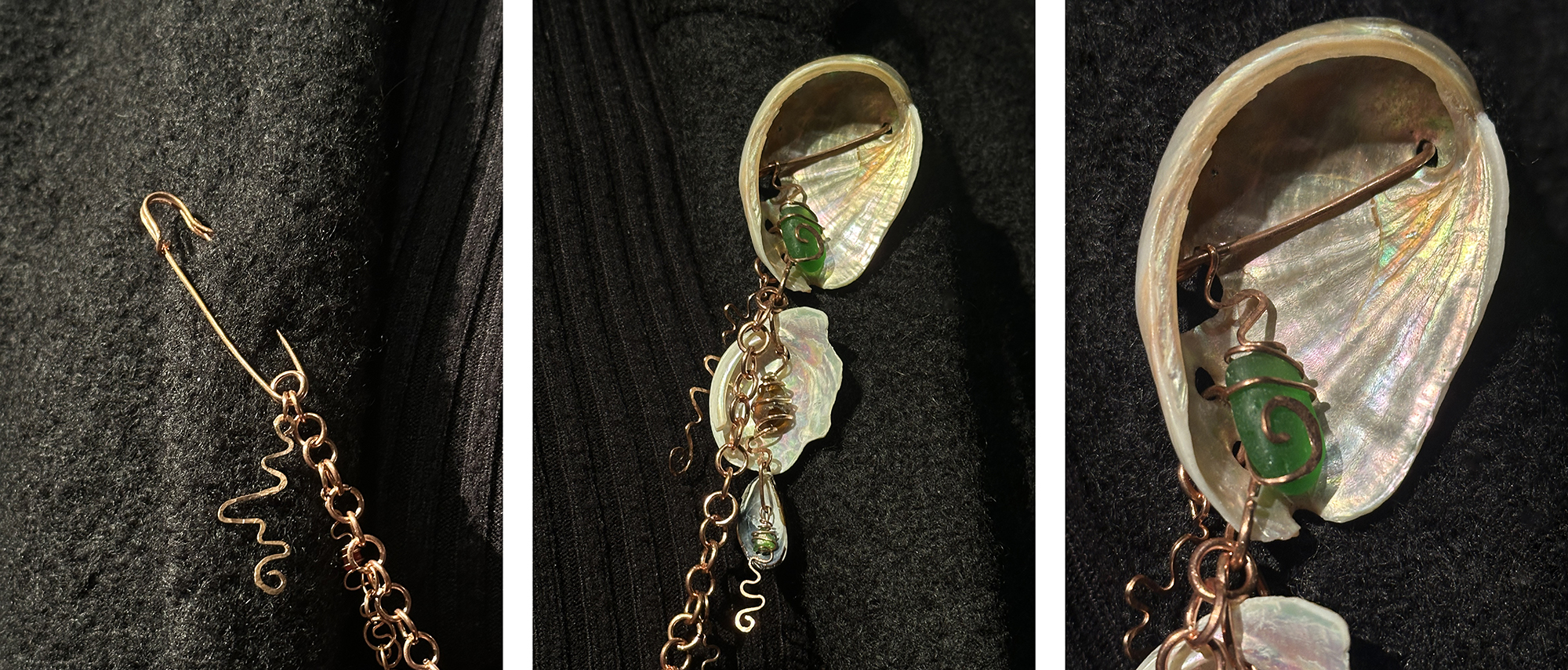
Like Lia Furch, Lea Fabian-Davies worked with found objects. Lea combed the beach, and collected shells and sea-glass for their piece. Copper wire was used to support and link the found materials together to make a double-broach that spanned from one lapel to the other. On the left, they made a safety pin that served as a visual and mechanical anchor point. On the right, another pin was created to hook the upper shell to the lapel through holes in the shell. The chain rings are perfectly circular and even in size, in the manner of a finely-made jewelry piece. Alexander Calder would have not employed such a perfect form, as he hand-forged every piece. Lea said that they wanted the rings to reflect and shine. Small dangling Calder-esque squiggles were added along the chain as accents.
The shells have an irredescent glow. Presenting the shells in this way make them jewel-like, precious, and revered. The presentation against a borrowed wool coat and textured black turtleneck make the colors more vibrant and beautiful. The larger green glass kernel offsets the hammered and work-hardened red copper wire that captures it. These complimentary colors are a pleasant contrast. When working only with cold connections, wrapping or perforating are common options for connecting such materials. In this case, wrapping was the best choice. Notice how the green of the glass works with the shell's green iridescence. And finally, look carefully for a small brown glass bead that, unlike the smallest green glass bead below it, is nearly invisible becuause it blends with the red copper wire.
Melissa Villanueva

Copper sheet was the material of choice for Melissa Villanueva. She created three pieces for the project: a pair of earrings, a bracelet, and a large necklace. The standout piece was the necklace, as it reflected brightly and with intense color. The warm metal red went well with her skin-tone in the studio light. The brown color of her shirt, and jet-black hair all set up a clean background for these objects. In this environment, the copper was more subtle than it would be against white or light colors. Melissa worked to make the curved moon shapes of the necklace fit the plane of her upper chest. She tried both orientations of the hammered forms, as seen in the last two images, below. In the middle image, the shapes are concave. In the right image, they are convex. Both are interesting, and while the latter seems to conform better, the former makes an interesting black shadow.