Considering Each Page as an Individual Pop-Up Sculpture
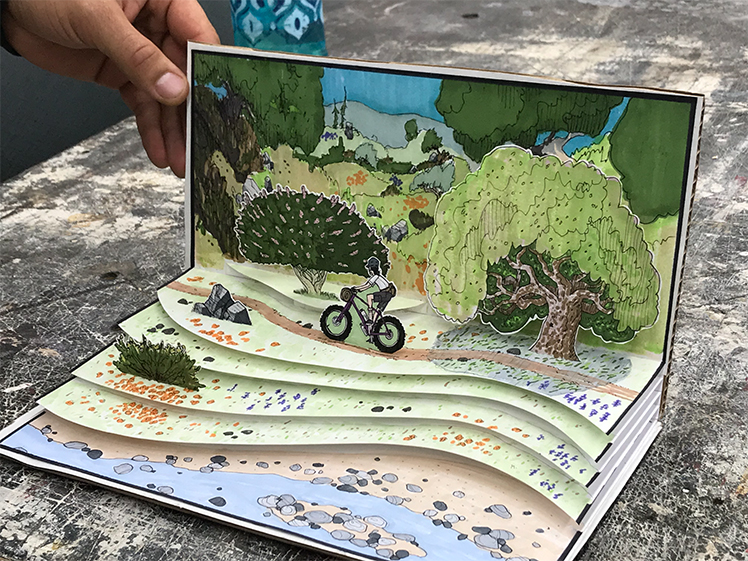
The pop-up above is an example of a stage view layout. It has a front view with a background to give it depth. In this example, the background contains perspective.
Each page should be filled by volumetrically and artistically complex pop-up structures that incorporate a range of mechanics, and produce a full, volumetric experience. They need to close completely flat, and open with ease. Each structure is to be strongly built, and if opened 90º reveals a stage view (shown in the image above). If opened completely to 180º, it should be in-the-round with art on all visible surfaces (shown in the image below). However, you want to keep in mind the orientation of the book, because you want all of your pages to make sense when each page is opened. If your reader must turn the book sideways or upside down each time they turn the page, it can become confusing (exceptions to this rule would be if you're doing a book about dizziness and vertigo, the disorientation of a funhouse, or have some other thematically justified reason).
Some semesters when we are short on time (such as when a fire or pandemic disrupt the schedule), we have a truncated version of the pop-up project where students only make three individual pop-up sculptures, and don't have to bind them into a book. The student examples on this page are of that sort. However, we have high expectations and know that you are all capable of making complex pop-ups for each of your pages.
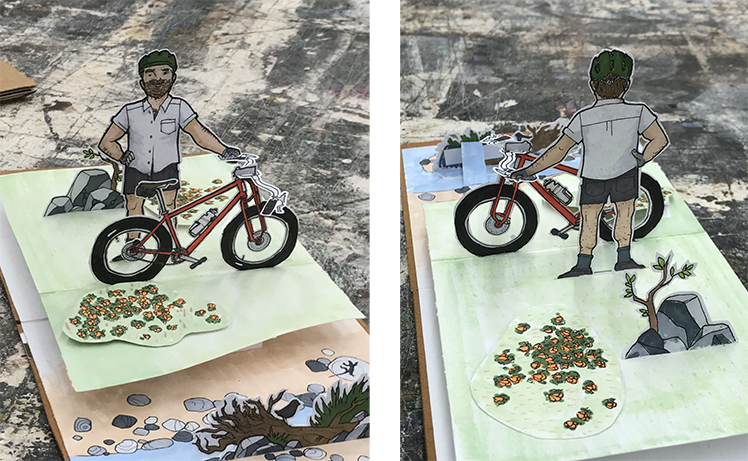
The images here show the in-the-round aspect of this scene. The back is just as important as the front.
Your results rely on a high standard of accomplishment. You are expected to do the best you can with all of the allotted time and available resources. Hard work is necessary in order to achieve a good result, and the reward ultimately goes far beyond a grade.
Before creating your finished pop-up books, you will be producing prototypes of the pop-up mechanisms which demonstrate underlying paper engineering concepts. These are not part of the final project, but will receive points, and must be completed prior to creating your pop-up book storyboard and prototypes of the pages themselves.
Once your storyboards are approved, you will begin work on the final pages. This entails making original artwork, seamlessly integrated into functional mechanics. If you wish to include text, it too must become an aesthetic element in your composition. Each page is an individual pop-up sculpture and work of art in its own right, but it must also relate to the other pages in a logical, visually cohesive, and thematically integral manner.
Below are four videos. The first is by an amazing, professional pop-up artist, Collette Fu. And the others depict three themed pieces by Jordan Balindo, a former student. His works are shown in the still images, above.
ABOVE: Tao Hua Yuan Ji, Source of the Peach Blossoms, by Collette Fu. Get ready to be very impressed!
ABOVE: Three pop-up scenes by Jordan Balindo, Spring, 2019. Copic markers on Bristol. Jordan is an avid naturalist and cyclist.