Text Student Examples
This page will discuss several student examples in detail. All of these projects got full marks, but they also have flaws that could be improved upon. It is rare that a student makes a book that is 100% ready for submission to an editor, but frequently students make work that could, with a number of adjustments, be of that quality.
I Don't Know If My Cat Likes Me by Juliana Saal, Fall 2021
This was a beautiful, complex, and incredibly personal book that nearly wasn't completed since Juliana's cat (whom this book is based on) tragically passed away right before the book was due. Just about every cat owner can relate to the story she has written, and it could probably become a successful published book with a bit more time to refine things. The text is well thought out, and although the mechanisms could be tweaked to fit the art and within the margins of the pages better, most of the mechanisms really take into account the principle of kinetic storytelling. If she wanted to seriously pursue publishing, I would recommend that Juliana rework several pages. The v-fold box mechanisms on the second spread needs to fit within the pages when the book is closed, and the cat could be less geometric. The most successful compositions are the ones where the cat fills the page and there isn't a lot of blank space. The final page needs something to make it more exciting so the book ends on a "Wow!" moment that matches the emotional tone of the last bit of text. Perhaps a pull tab or volvelle with pivots to make the cat's paws have an alternating motion would make it more impactful.
Sousiva Ing, Spring 2021
This mini book by Sousiva Ing uses minimal text to convey a full story. It is hand written, and offset from the art by a color shift because she wrote all of her text on pink paper which she cut and pasted onto the pages. This pop-up book is all around adorable from the size, to the story, to the character designs, art style, and her handwriting which is both legible and matches the style of the art. She did a great job balancing the text with the art, and incorporating it into the compositions and on the mechanisms in logical and graphic ways. The aesthetic and tone are consistent throughout, and she clearly met all of the project criteria. I was a little surprised that the second mechanism worked as well as it did, since typically you want to avoid placing that type of mechanism (a changing-picture pull tab, also called a dissolve or window blinds mechanism) over the gutter. It appeared to function well in the video, but Sousiva turned the page before returning the mechanism to its closed position, and it likely got bent out of shape.
Given the size and simplicity of this book, this feels much more like a one-off art object than something that might be mass produced. Perhaps if it were part of a series of mini pop-up stories it would be more marketable. However, not everything you make needs to be something saleable. We talk about production considerations, publishing, and the like because this is a design class, but the books you make can be personal, individual, and created without thought towards publication if that isn't your goal.
Can you guess what the biggest negative critique of this book was? When we discussed this book in class, the main point that people mentioned was that the video had been shot vertically, and everyone wished it was horizontal so we could get a better view of Sousiva's hard work.
Nicole Harden, Spring 2021
Nicole Harden did a fantastic job on this book. She made a very striking book with a strong cohesive style, using a different color which corresponded to the featured planet for behind the text on each spread to make the color scheme cohesive, and using images from NASA and the JPL that are in the public domain (note the attribution on the first page, and check out the Copyrights page for how to find and use public domain and creative commons images). Because her book is so well done, there is a possibility she might want to pursue publication. If she did that, there are a number of issues she could address to make this a stronger submission for a publication house.
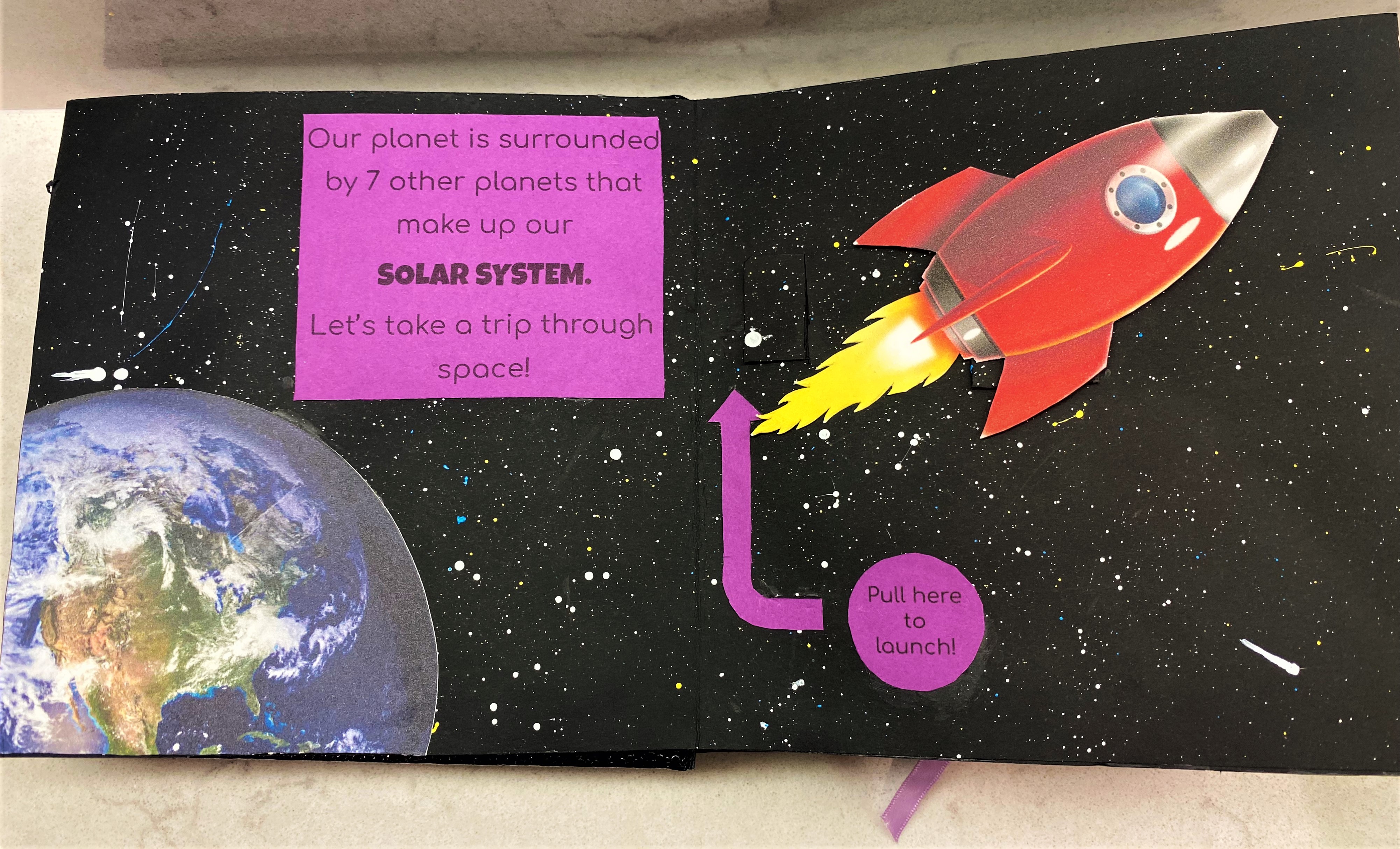
The first thing I see is that she labeled and described every pull tab and lift-able flap to let readers know exactly what will happen. If she instead just wrote "pull" or "lift," there would be a moment of anticipation followed by surprise and discovery. Since science is all about discovering the unknown, this would reinforce the theme of space exploration. She also might consider ways in which to make the rocket launch from the surface of earth itself for greater continuity.
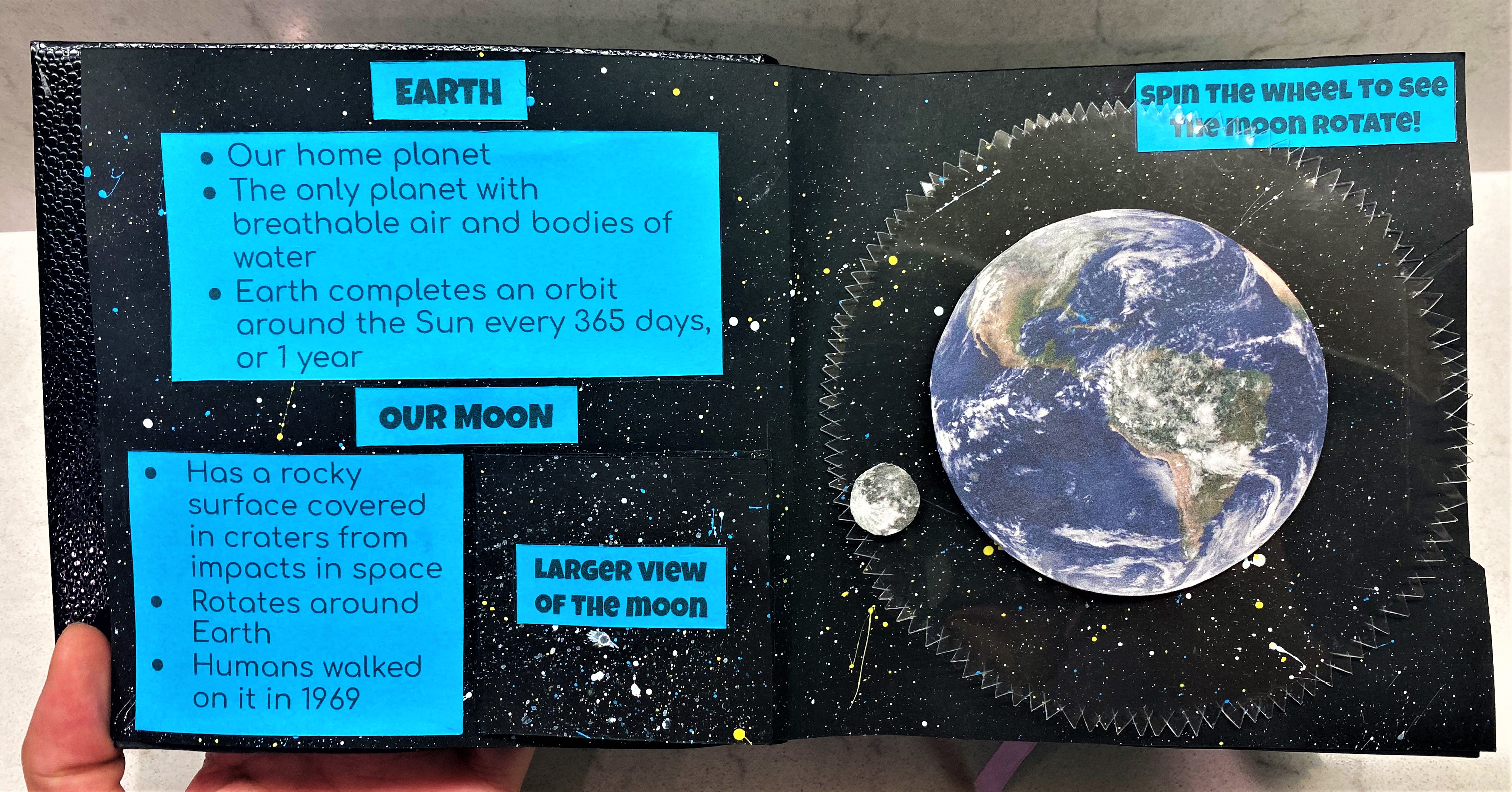
For the sun, Mercury, and Venus It would be nice to continue the full circle of their images down onto the page on which the pop-up mechanisms sit, rather than having them cut off abruptly when they hit the page. And on the next page, the clear plastic used for the wheel showing the moon's orbit would be less distracting and equally functional without all of the serrations around the edge.
I would also be interested in seeing the rocket travel from page to page. It would be fun to have a narrative element as part of the art, especially if there was an astronaut visible in the rocket's window. Nicole could tell an entire story about the rocket dodging asteroids or orbiting a planet without having to say a word, just by including it on the page. It could even be kind of like an "I spy" game, where the rocket is somewhat hidden in each spread and the reader must search for it.
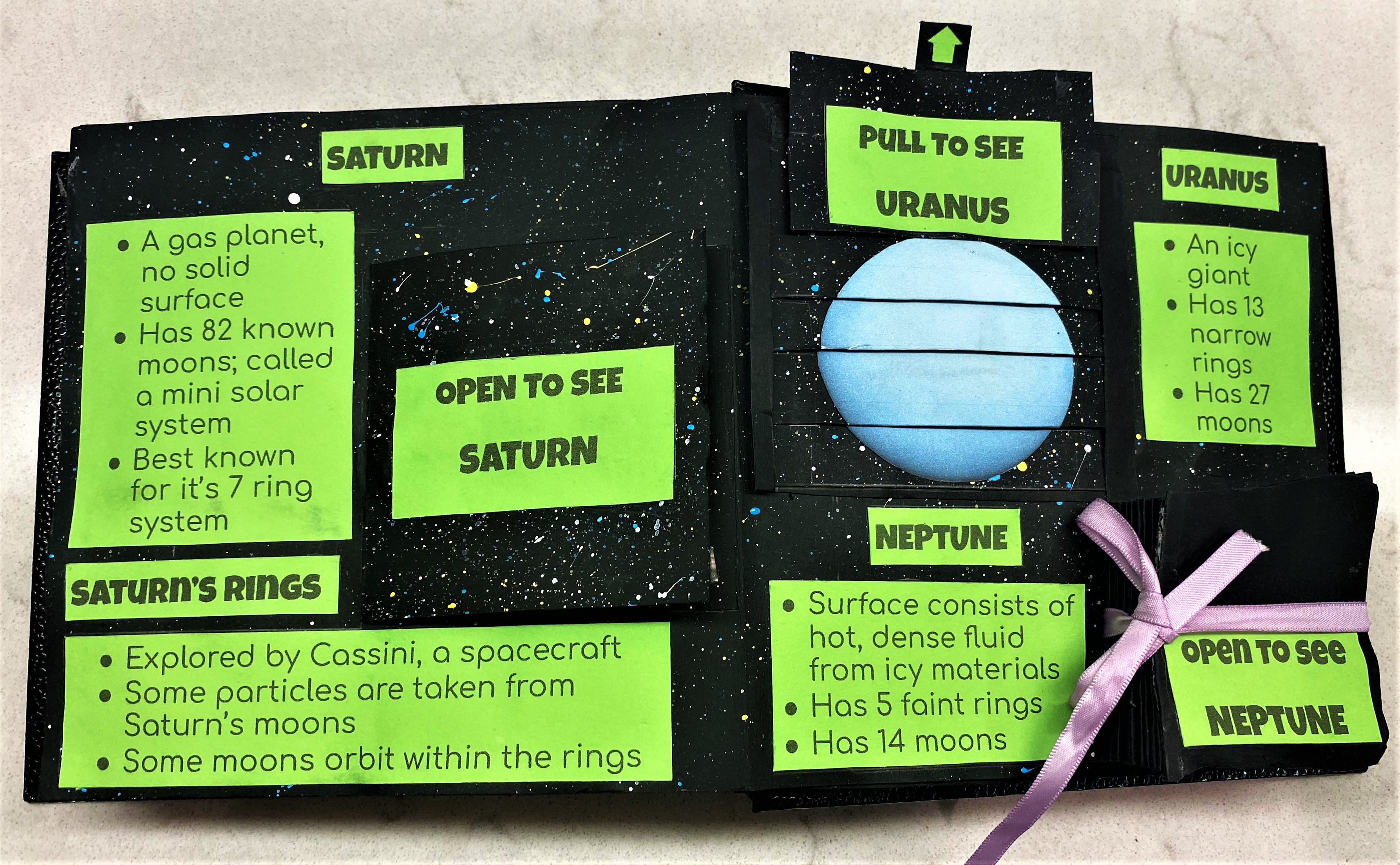
Here I would consider using the window blinds mechanism for Jupiter instead of Uranus, since the lines that cut across it would be more hidden amongst the striations of Jupiter's atmosphere, whereas Uranus is one of the most featureless of the gas giants. Perhaps Nicole could make Neptune and Uranus on a spin wheel and only have them become visible when a telescope points to them, since Uranus was the first planet discovered by telescope.
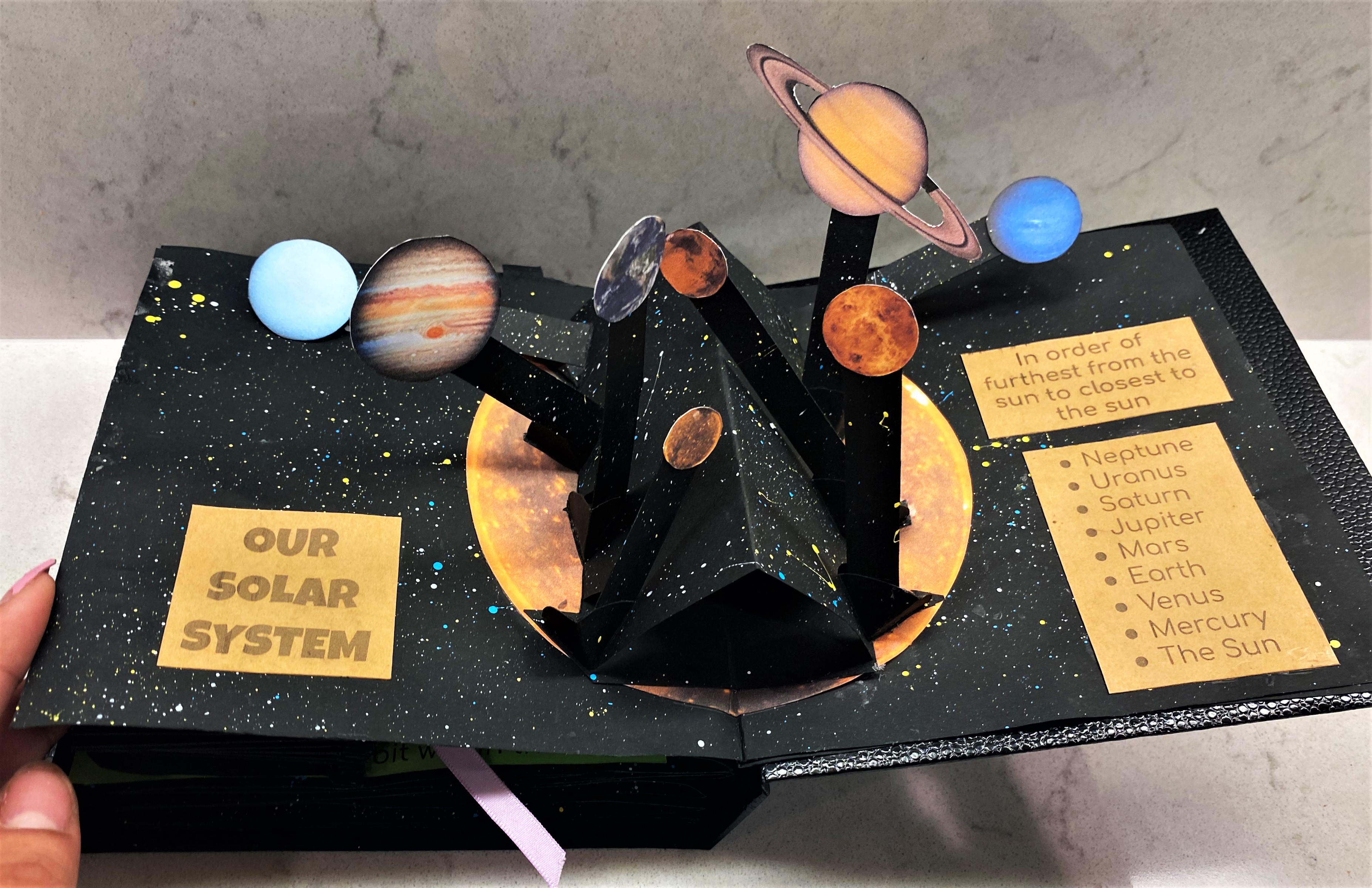
This final mechanism is certainly large and volumetric, but the planets are all a bit jumbled together and the sun is sitting directly underneath the dark black mechanism. This could be refined more so the positions of the planets is more strategic, and the sun could be placed better.
All of her text is clearly legible, but it can compete with the art when it is such a strong, graphic element. If she were to refine her designs and try to get this book published, she might consider using colored borders around her text, and making the actual writing white on black so it is less of a distraction from the pop-ups.