Automatic vs. Interactive Mechanisms
Although all pop-ups are intrinsically interactive by simply opening a book or card, there is a distinction between turning a page versus having to engage in other ways afterwards. The simplest experience is when all mechanisms activate as the page is opened. This is considered automatic. The other type of experience is interactive, where physical actions are required beyond turning the page. Combining the two is the most interesting: open a page to an incredible spatial experience, and then discover the various mechanisms that beg to be tried! Of course, spectacular and beautiful pop up books have been created that are completely automatic, and in some ways, this purity is very satisfying too.
This brings up a dilemma: whether to create a book that incorporates sculptural volume or one that is completely flat. If the interactions are interesting enough, then flat pages can be as engaging as sculptural ones. However, integrating interactive mechanics into sculptural forms is very engaging, albeit more complex. Many books are dedicated to purely flat interactive mechanics, which from a problem solving point of view, and an aesthetic book-creating perspective, is perfectly fine.
For purposes of the Pop-up Book Project, try to limit flat pages when integrating interactive elements. Remember that sculptural composition is a major part of the project.
Below are classes of interactive mechanisms that can either work as stand-alone flat mechanics or be integrated into sculptural forms. The finger slot mechanism integrates very well into scenery flats and platforms, and is actually more difficult to keep totally flat.
Pull Tab
There are many forms of physical interaction, though the most common in pop-ups are pull tabs. These are protruding reinforced paper tabs that are integrated into the structure of the spread that can easily be grabbed. Usually they are obvious and have some kind of visual indicator of expectation, such as arrows, or the word 'pull' printed on them. Pull tabs can be designed to pull out or push in. This action provides the power to drive either a 3-dimensional pop-up mechanism, a series of levers, a waterfall mechanism, a flap, or all manner of ingenious creations. Pull tabs must be robust to withstand the forces applied, especially if little children are involved. They have to be designed with limits to movement. These limits are called. "stops".
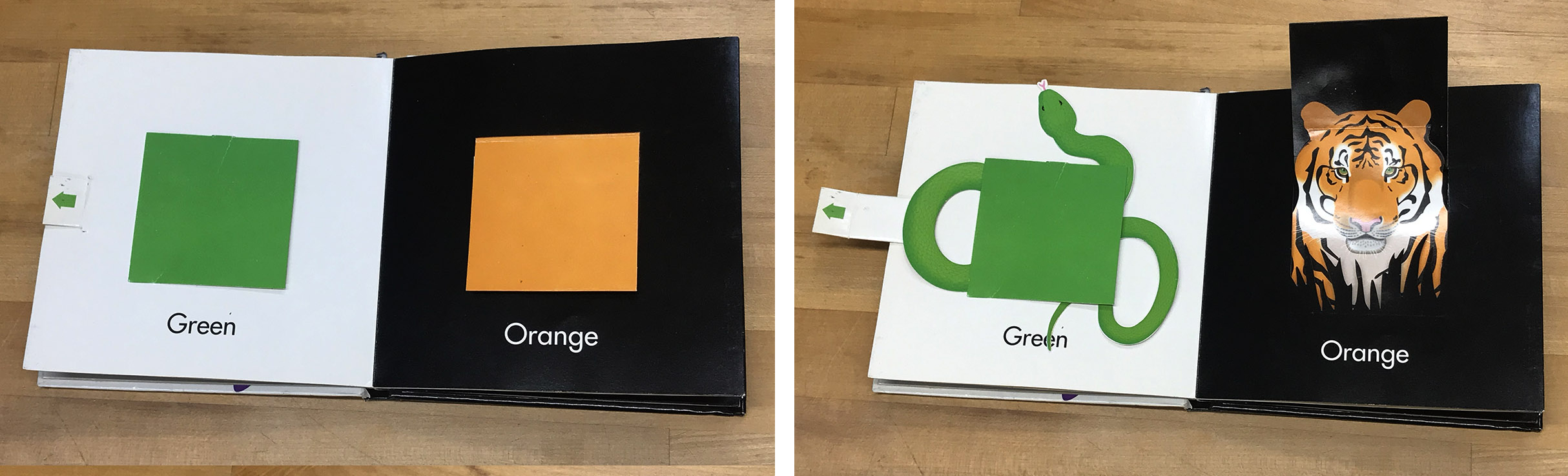
If combined with levers, pull tabs can be made to trace arcs or be incorporated into rotating blinds. As seen in Chuck Murphy's Color Surprises, the green page has an obvious pull tab with a green arrow indicating the desired action. Notice that the pull tab tucks into a slit in the page near the arrow. When pulled, the left part of the snake moves at the pace and direction of the pull tab. The head of the snake swings up in an arching movement clockwise to the right, and the tail and right coil swings down and counterclockwise. The result is indeed a surprise, as the title of the book implies. If the book is closed while the snake is extended, the mechanism will not be crushed, but the pull tab will stick out of the book and risk damage. It is best to always return pull tabs to their previous state before closing a page.
It is imperative that pull tabs take into consideration the folding of a book or card. They must not be designed such that forgetting to reset them risks their destruction when the page is turned. At the very least, the overall mechanics should be robust so that the accidental turning of the page will stop against the open mechanism. Consider if the mechanism should cross the gutter. Typically it should not, as the chance for damage is increased remarkably.
Pull tabs often utilize the space between leaves of the book, so the leaves must have adequate space to accommodate the free movement of the mechanism. On the occasion where pull tabs are present on both spreads on opposite sides of the leaf, a thin paper shield (slip sheet) should be utilized to prevent the mechanisms from colliding or interfering with one another. This concept is shown in the Rotating Tab section, below.
Interestingly, any pull tab mechanism can also be made automatic by bridging it across the gutter and attaching it to the opposite page. But this would defeat the interactivity aspect, if that was what you wanted to achieve.
Rotating Tab
The cousin of the pull tab is the rotating tab, which traces an arc about a fixed radius point. Rotating tabs have hard limits, or stops, designed to take abuse. They are used to activate rotating blinds or other arcing movements. In combination with levers, they can translate into linear motion. Ribbon can be added to the end of the tab for aesthetic reasons or to make it easier to grab.
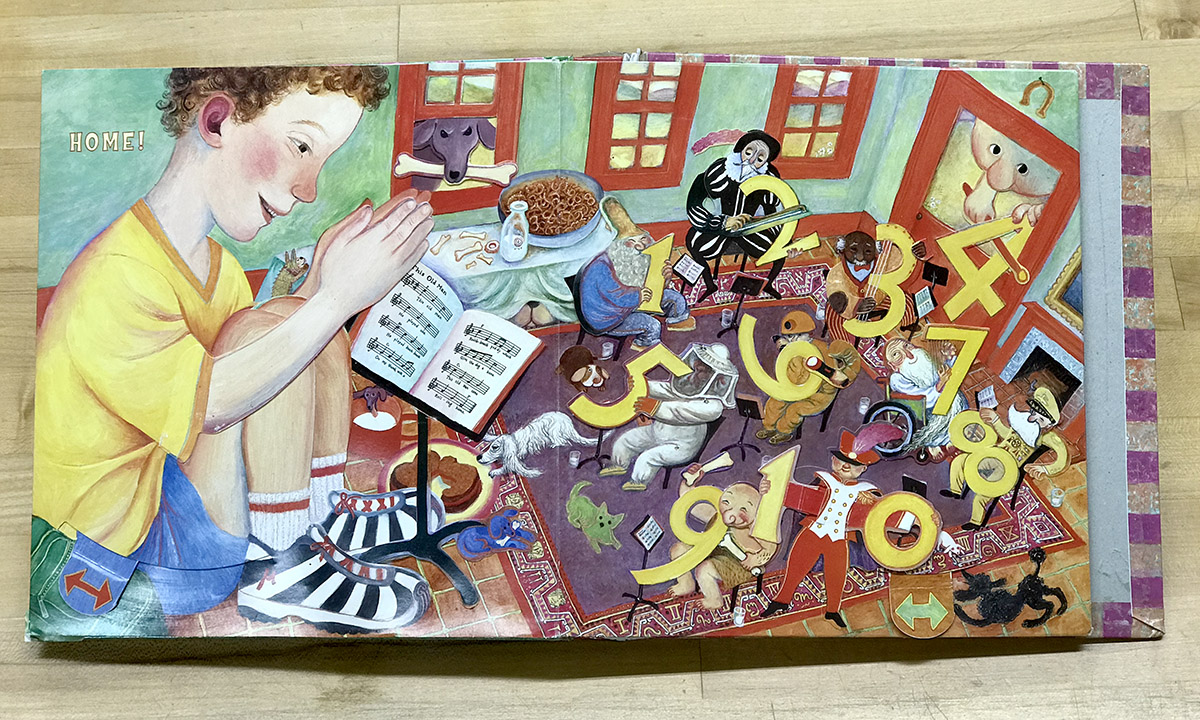
As seen in Knick Knack Paddywhack, there are two rotating tabs on this spread. One is located in the lower left of the left page and has red arrows. This movement allows the boy to clap his hands, and movement is confined to the left page on the spread. The green arrowed rotating tab on the lower right of the right page activates an astonishing array of mechanisms related to each numbered creature. Below is an image showing the 'behind the scenes' action that takes place between the leaves of the book. As incredible as this design is mechanically, it is visually very cluttered. It is not easy to find the tabs or follow all of the actions. The artistic style seems to get in the way of the mechanical aspects.
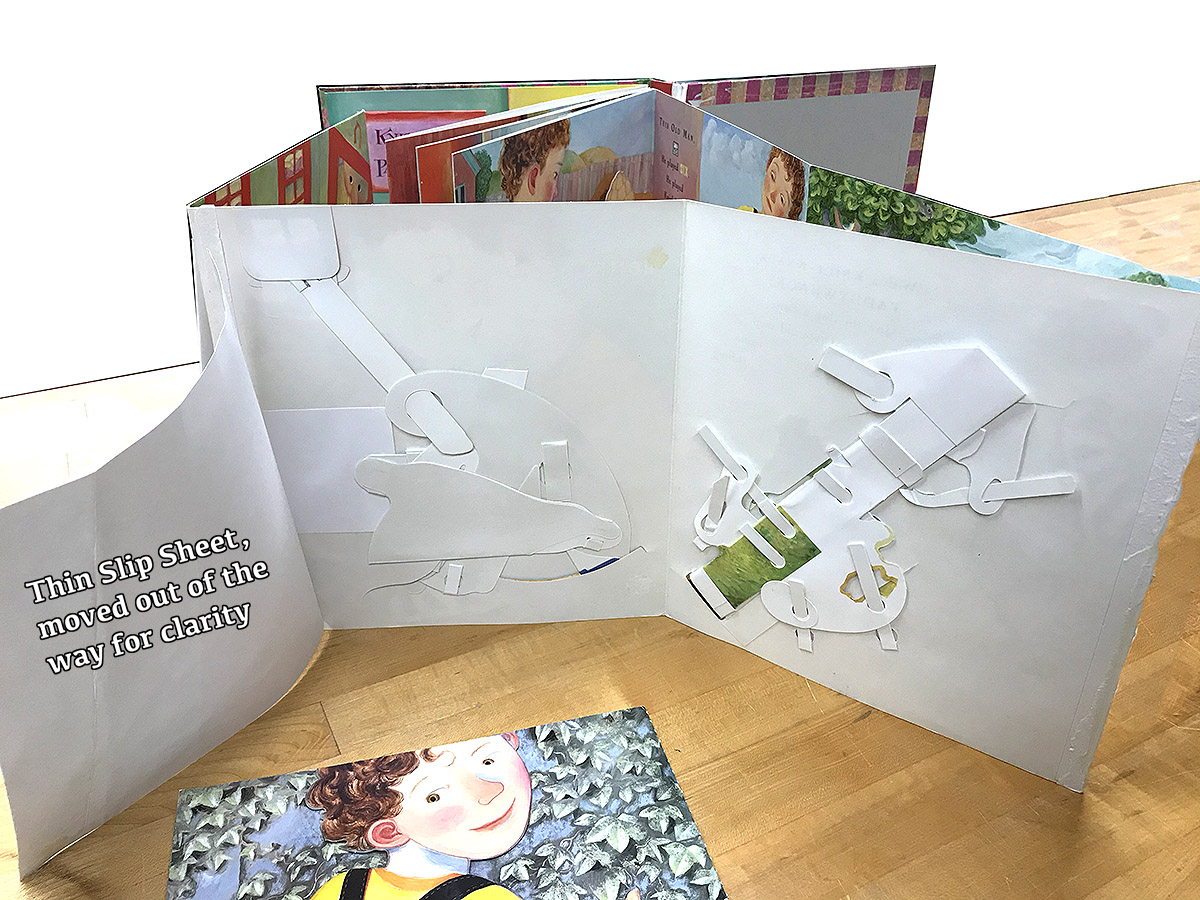
The Knick Knack Paddywhack book is a testament to just how complex mechanisms can become. Overall, the book has problems with robustness, visual clarity, and functional reliability. This goes with a saying in the engineering world about mechanisms that rely on precision and complexity to function: they are more apt to fail. Mechanisms designed to function under lower tolerances not only last longer, but are also easier to repair.
Finger Slot
Another type of interactive mechanism is the finger slot. This allows the user to insert a finger and slide a mechanism. For this to work well, there needs to be enough open space behind the opening for the finger to fit into. The "tube side" used in the book, PETER AND THE WOLF, is a fine example. In this design, a parallel scenery flat creates a guided space for a rectangular tube to slide smoothly left and right behind the scenery flat and under the support arm.
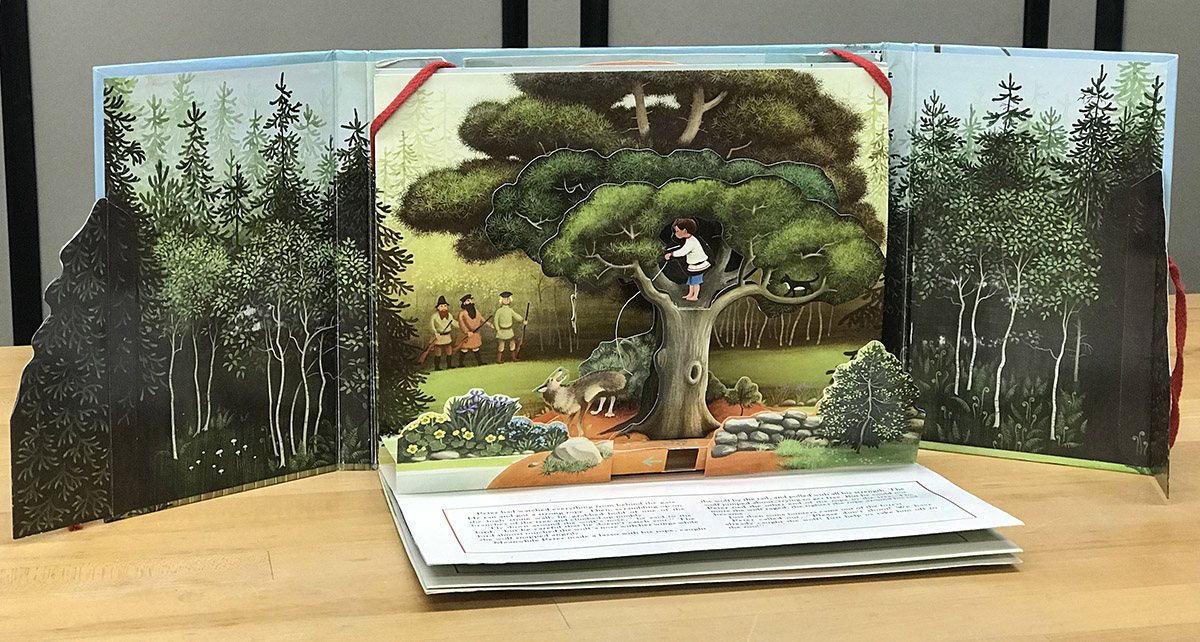
In this example the tube slide is activated by the finger slot, which further moves the boy in the tree and the wolf on the ground. Notice how all mechanisms, no matter their position, will still fold into the book when closed without damage. This is an excellent and reliable design. The finger slot has an arrow showing that the movement is to the left. When moved to the left, a right arrow is revealed. The hard limits, or stops, are the edges of the opening in the scenery flat, allowing for about 2 inches of movement. The tube slide inside the scenery flat is long enough to be strong and provide reliable movement/linkages to the other mechanics, but also small enough not to protrude from the page when slid left or right.
Rotating Wheel
A simple mechanism is a rotating wheel that is accessed along its circumference, usually at the outer edge of a page. There is typically a curved indentation on the page edge allowing access to the wheel. The wheel edge can either be smooth or cogged for grip. Rotating wheels should not cross the gutter, unless they are on a raised platform, in which case they will cross the gutter upon opening the spread, then move away from the gutter when closed. Rotating wheels often freely rotate clockwise and counter clockwise without restriction or stops. These are useful for visual effects like Moiré patterns, arrow spinners, changing windows and the like.
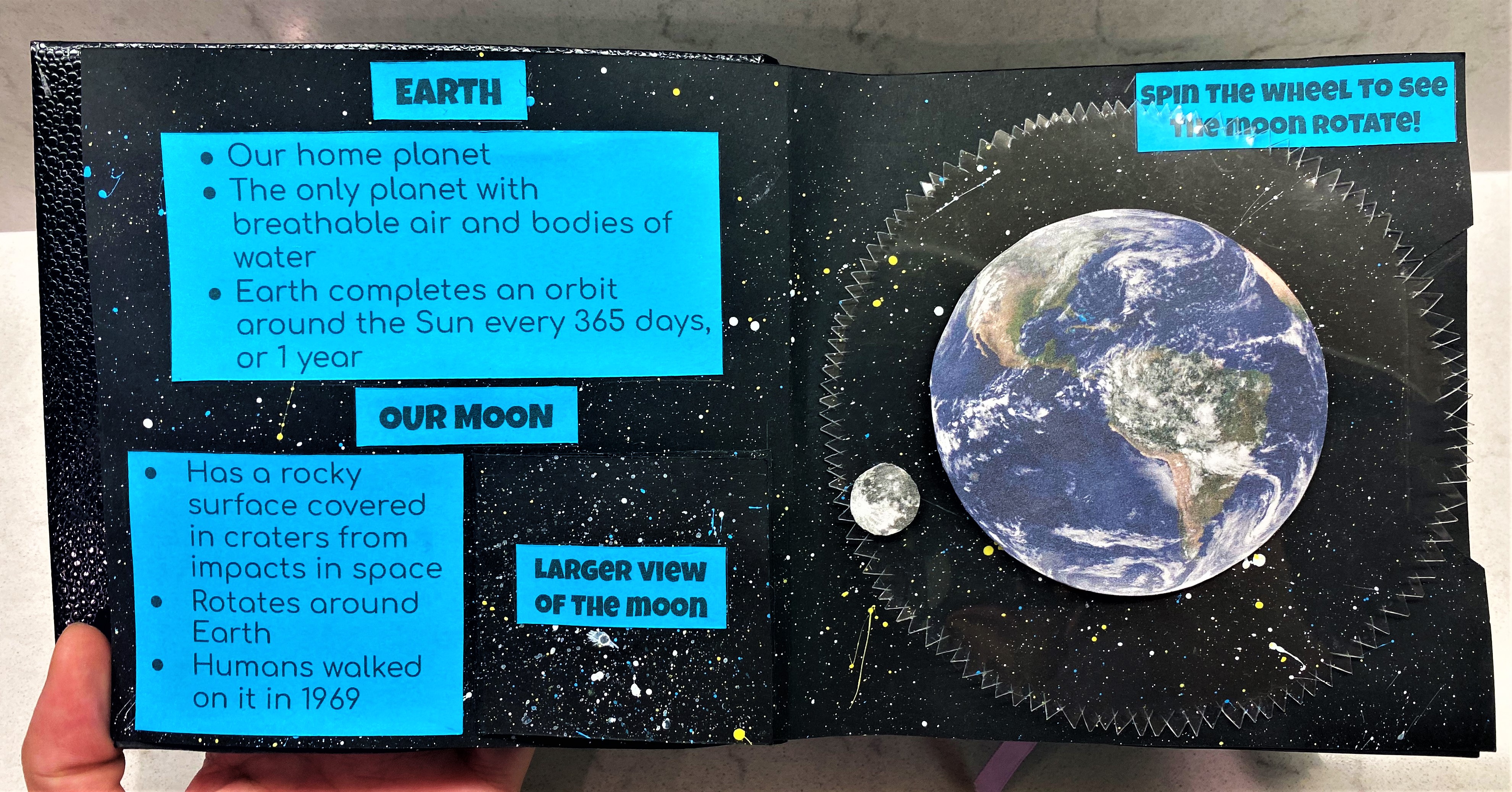
Student, Nicole Harden, made a book about the solar system, and in it there is a page about the moon orbiting the earth. The mechanism is a rotating wheel. It is special in one aspect: the wheel is cleverly a transparent sheet of plastic upon which the moon is affixed.
The teeth on the wheel are accessible via the cutout on the right edge of the right page. The earth is fixed in place, concealing the pivot mechanism that allows the spinner to rotate freely. Because the moon is on a transparent layer, the stars behind it remain fixed. Notice how large the wheel is, fully utilizing the entire right half of the spread, not crossing over the gutter. This mechanism could be improved by reducing the sharpness of the teeth on the wheel, increasing the finger access to the wheel edge, and by actually placing the toothed edge of the wheel behind the page layer, whereby the teeth could be hidden from view, except where accessed on the right edge.
By the way, in Nicole's piece under the text, "Larger View of The Moon", there is a square flap. It is well camouflaged by stars. Open the flap for the larger view of the moon! There are a few options that may occur under there: it could be that the moon is the size of the rectangle itself with more stars or text on the opposite flap; it could also be a zoomed in half view of the moon across both flaps; or she could have employed a shallow acute v-fold, glued in at near 180 degrees, and made a moon four times bigger than the flap.
Emiko Ogasawara gave this book a thorough review, which is quite useful to read. It can be found under the "Text: Case Studies" page.
Flaps
Flaps are merely page folds that are added into an existing spread, and in themselves are the simplest interactive elements to construct. In the sections on pull tabs and rotating wheels, both spreads illustrated also have flaps designed into them. In "Chuck Murphy's Color Surprises", the orange square is a flap revealing a tiger. In Nicole Harden's book on the solar system, the flap reveals a closeup of the moon. In Chuck's book the flap is deliberately highly visible, whereas Nicole's is intentionally hidden. Both are simply squares.
Because flaps are so elementary, in their simplest form where the open flap is just flat, their appeal is limited to babies and toddlers, who can be surprised by the most mundane of things. Consider that the hinge or gutter of the flap is a potential power source for making a three dimensional structure or moving other mechanical components. These options can make the flap very intriguing.
Flaps can be used for many reasons such as revealing a riddle, concealing a lot of text that would otherwise not fit on the spread, answering a question, expanding the size of the spread, or other clever reasons. The flap can even be a book inside of a book, were it has multiple pages to leaf through.
The shape of a flap is very commonly a rectangle. This is true in every example on this webpage. Remember that a square is also a rectangle. Also, in all of these examples, the hinges either fold to the left, right, or top. However, there is no limit to the shape of the flap, or the orientation of its hinge. A flap can be shaped like an apple, or be hinged at a diagonal. One thing to consider though is how long the hinge needs to be for strength, or to deliver mechanical advantage. Also, if a flap opens over the gutter, it will probably automatically close upon closing the main spread. Whereas flaps that open away from the gutter or do not overlap it at all will most likely stay open when the spread is closed. As with all interactive mechanisms it is best to reset the flap before closing the spread.
A flap that has a tendency to open itself can be held closed with a tab, ribbon, tied string, Velcro, or even a small magnet. Likewise, these features can be used to keep it held open. A locking mechanism can be integrated into its design such as a hasp, swinging hook, snap, or other piece of hardware, as long as it is aesthetically appropriate, mechanically sound, and thin enough to let the page close properly.
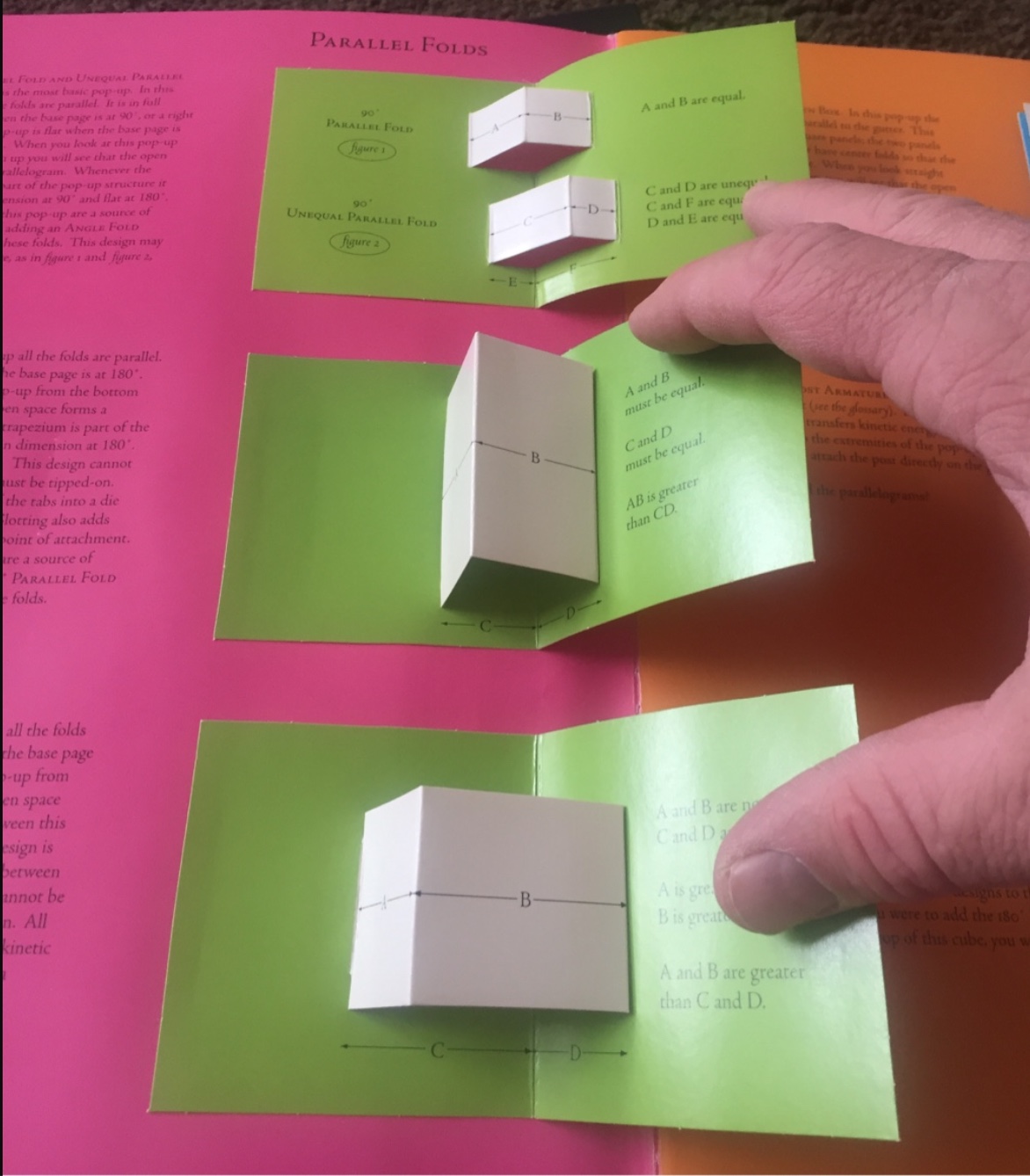
In, "The Elements of Pop-Up", flaps are commonplace. In fact at least half of the book has six flaps per spread. This book is not particularly beautiful or technically awesome. Instead it is an educational how-to book that is wildly popular, and inspires the phrase, "why didn't I think of that?"
There is a visual theme and color scheme to the book, which is beneficial in helping the user understand the information. Every flap has a descriptor to its left, and then in activating the flap, the concept is physically demonstrated and further described in text.