Storyboard Defined
Part of creating a cohesive storyline for a pop-up book is to make a storyboard. This is a series of sketches of your ideas for each spread. It allows you to plan the pacing of your image layout, text placement, and necessary pop-up mechanisms. Most importantly, it lets you see your book as a whole before you begin work on the final art, allowing you to spot and fix any major problems or design changes early. It is much more developed than the storyline, and should contain all desired text.
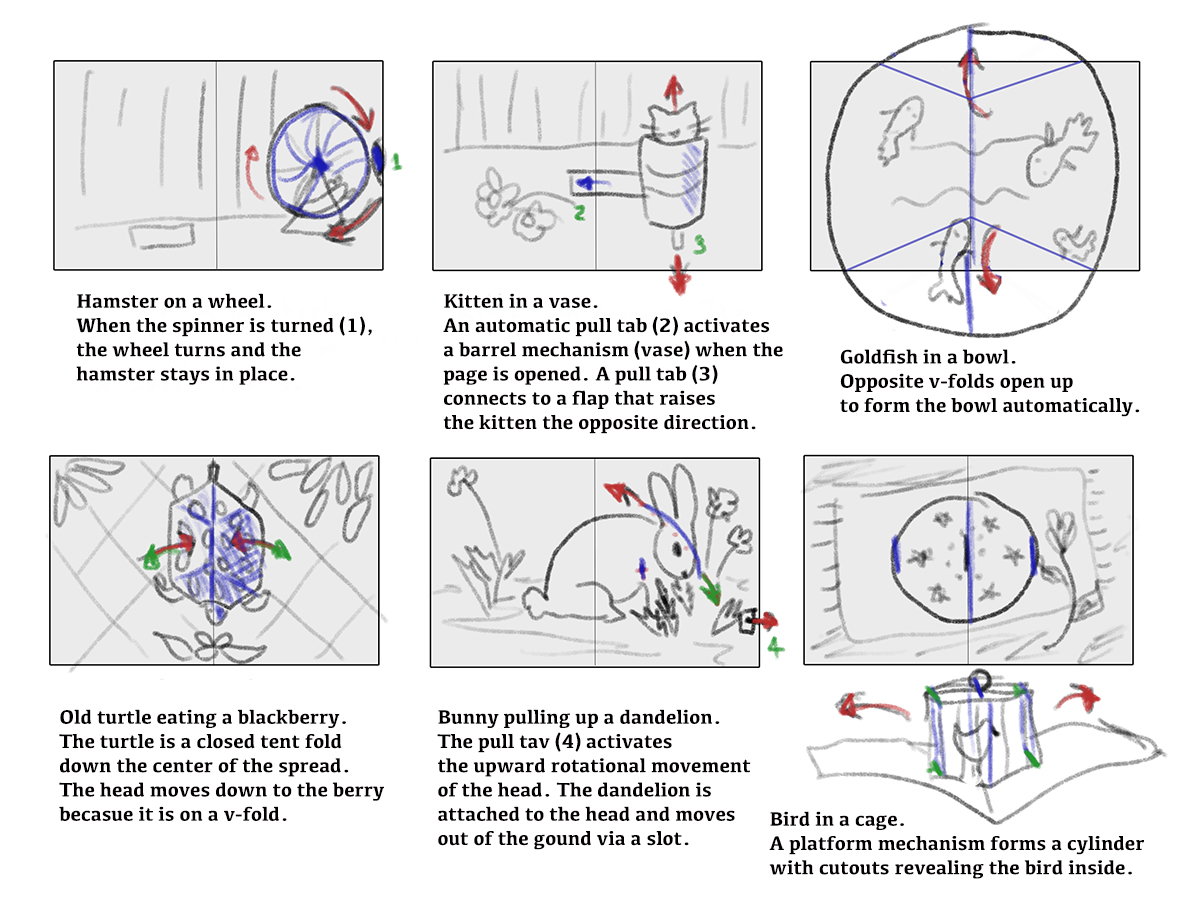
The example storyboard above contains all of the elements to be incorporated into the book, including the basic composition, types of paper engineering and interactive pull tabs. Although the book has no text, there are written descriptions below each spread.
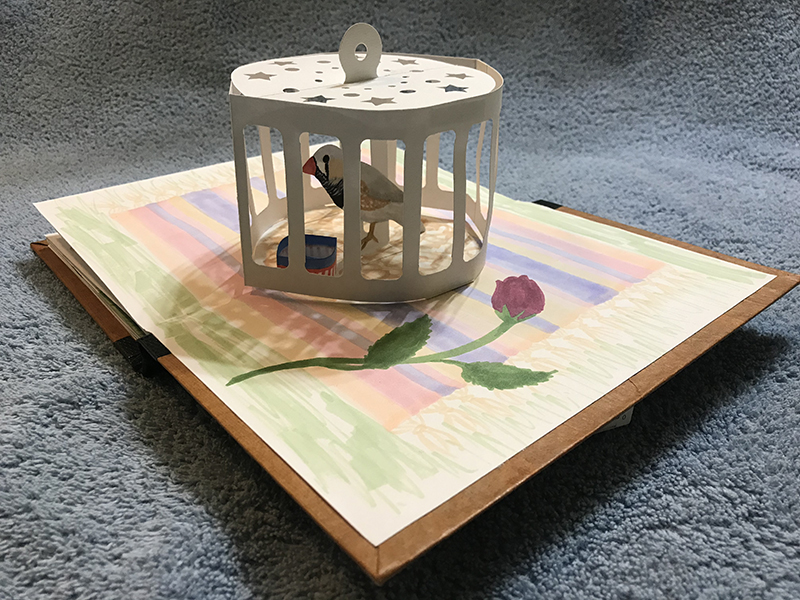
Above is the bird in a cage spread from Laura's finished book. Note the bird that is part of the central tube-post-armature that gives the the cylinder its structure, and the smaller open-topped cylinder mechanism that makes the dish of birdseed inside of the larger cylinder. This is one way to compound mechanisms for a more complex, in-the-round composition.
The example storyboard above uses lots of different mechanical elements. On the first spread, there is a rotating wheel activated by a cutout on the right edge of the spread. Because the mechanism has to be on one side of the fold line, there is little activity on the left half of the spread. Either another pop-up mechanism can be added there, or the space can simply incorporate another visual element to complete the composition. For example, a hamster water bottle. The art should fill the entire spread so the eye is carried all around to alight on different aspects of the mechanisms, text, and illustrations.
The storyboard should be laid out as a unit on one sheet of paper so that you can review the whole at one time. All six spreads should be visible at once.
The initial drawing should be created quickly and to the point. It can be edited until you like the results. You can use any drawing medium you choose, including digital, but before you finalize the idea, make sure you are using a medium that can be undone or erased. You can then strengthen the sketch with more permanent media if this helps with visual clarity.
Include:
- A complete compositional layout of each spread, illustrating how the images fill the space
- Basic paper mechanisms, pivot and tab locations, and folds
- Arrows indicating the type of movement expected
- Minimal shading to indicate which elements are 3-dimensional versus flat on the page
- Position of text on the spread, with the actual text written below the spread
- A short description of the mechanism type and any other necessary descriptors
Useful Links:
Here is an interesting read: Every picture book author should make a storyboard. The author addresses picture book storyboards, and not that of a pop-up book, but the concept is similar. Of course, the pop-up book is composed of spreads rather than pages, and there are only six of them.